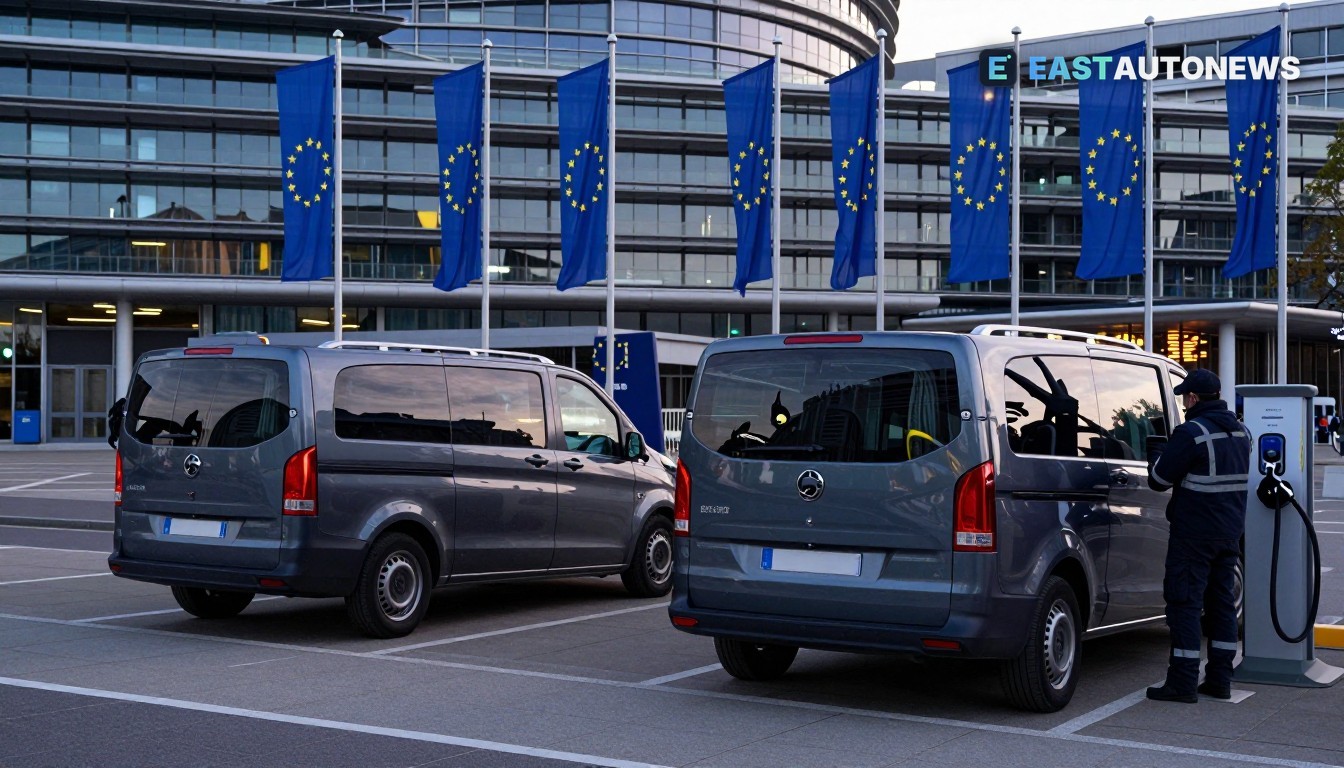
On 4 November 2026 the European Parliament’s Environment, Public Health and Food Safety Committee (ENVI) adopted a negotiating position that weakens the bloc’s 2035 emissions ambition for new cars: the committee set a base 2035 fleet‑wide CO2 reduction at 87.5% compared with the 2021 reference, with manufacturers able to top this up by up to 7.5 percentage points through credits for EU‑made low‑carbon steel. The draft was adopted in committee by 48 votes in favour, 30 against and 2 abstentions.
What was decided
ENVI’s text replaces the earlier de‑facto 100% zero‑tailpipe target for 2035 with a framework that allows flexibility for industry. Under the committee proposal manufacturers could count certain EU‑built small and very efficient battery EVs as more than one sale (so‑called “super‑credits”: small EU BEVs up to 4.2m would count as 1.4 vehicles and highly efficient EVs as 1.2) and could offset a portion of fleet emissions using low‑carbon steel credits; for vans the committee proposed lower 2030 and 2035 cuts (35% by 2030 and 80% by 2035 under the draft). Parliamentary committees also downgraded previously mandatory targets for corporate fleets to non‑binding, “aspirational” goals.
Rapporteur Massimiliano Salini (EPP, IT) framed the change as protecting the EU auto supply chain and preserving technological choice: “Our agreement marks a turning point for the European automotive industry... Registering combustion engine cars without compensation obligations would remain possible, protecting technological freedom and restoring prospects for the entire supply chain.”
Why the committees made the change
The move follows months of industry and national government pressure. The European Commission’s late‑2025 Auto Package had already proposed easing the 2035 deadline to a 90% reduction with compensations; committee negotiators from the centre‑right, social‑democrat and liberal groups pressed further to widen the compliance toolbox for manufacturers. Industry bodies offered cautious welcome, while environmental groups warned the change risks slowing electrification.
What this means for the market
For Central and Eastern Europe the committee vote matters because many OEMs and suppliers in the region supply powertrains, stamping and components into EU‑built cars. The revision changes the business case for models and components: super‑credits favour production of small, highly efficient EVs in the EU (which could benefit CEE assembly lines that produce compact models), while low‑carbon steel credits create a potential demand signal for cleaner steel across European mills. Eurofer welcomed the vote as a booster for low‑carbon steel demand, saying a dedicated steel credit would “reward carmakers for using qualifying low‑carbon steel, helping create demand for cleaner steel”.
At the same time the market context is mixed: battery‑electric registrations are already rising quickly (battery‑electric cars accounted for 22.7% of EU new registrations in January–September 2026, ACEA provisional data), so manufacturers face the twin challenge of meeting growing BEV demand while managing the cost of decarbonising supply chains and batteries. The committee package opens room for technology‑neutral compliance, but does not remove the need for rapid EV roll‑out and local battery and skills investments.
The committee report now moves to the European Parliament plenary, where a vote is expected in December 2026; after that Parliament’s mandate would enter negotiations with EU member states in the Council, where the final shape of the law will be decided. Stakeholders in CEE—OEMs, parts suppliers, steelmakers and national governments—should track the December plenary and subsequent Council deliberations closely.
Electric cars on WorldTrader24 →
Sources: Reuters (syndicated reporting), European Parliament press materials, Electrive, ACEA, Eurofer, Autocar.