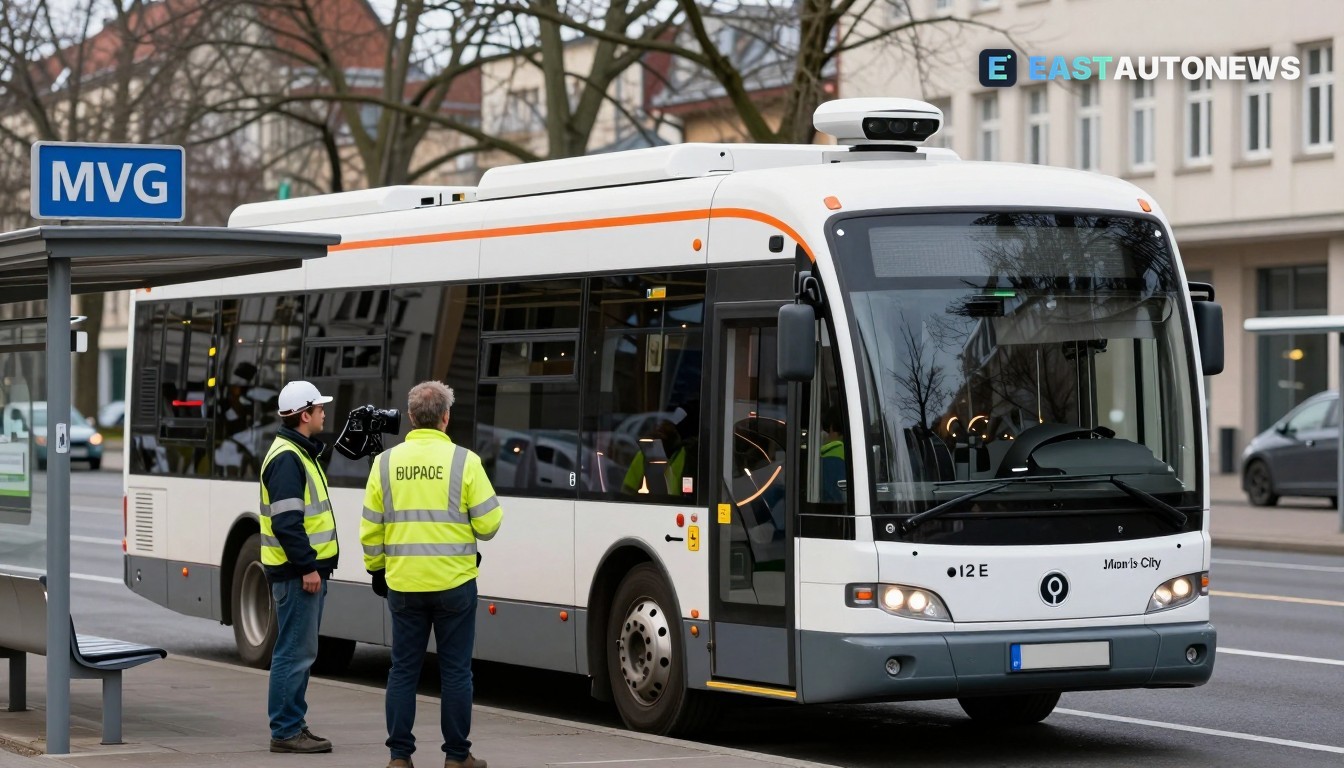
MAN Truck & Bus, Stadtwerke München (SWM) and Münchner Verkehrsgesellschaft (MVG) will begin passenger test rides on an automated MAN Lion’s City 12 E on November 17, 2026, operating Monday–Friday along MVG route 178 in northern Munich. The rides are limited to a closed test group and are scheduled to run through June 2027, with specially trained safety drivers remaining on board at all times.
Trial scope and technology
The 12‑metre electric bus has been collecting route data on public roads since early September and is equipped with five LiDAR units, six radar sensors, eight cameras and satellite‑based positioning to support high‑resolution mapping and automated control. More than 2,000 residents have pre‑registered to join the closed test pool, the partners say. The MINGA consortium comprises 16 partners and the project is backed by roughly €13 million in federal funding; scientific monitoring will be carried out by the Technical University of Munich and the University of Stuttgart.
MAN says the vehicle steers, accelerates, brakes and signals autonomously on the prepared route but that safety drivers can take immediate control if necessary. The automated bus was developed in cooperation with technology partner ADASTEC, which supplies the Flowride.ai Level‑4 automated driving stack used in the vehicle. The partners invited the press to an initial public test ride prior to the passenger‑trial phase.
What this means for the market
For suppliers and tier‑n vendors across Central and Eastern Europe, the Munich MINGA trial is an important demonstration of Europe‑led L4 deployment in constrained urban domains. The project shifts the conversation from laboratory and depot tests to user experience, accessibility and operation under real traffic conditions — areas that planners, software suppliers, sensor makers and integration houses will be asked to address as pilots scale. While MAN’s trial is a public‑transport pilot in Germany, component makers in the CEE region that supply LiDAR, radar, camera modules, satellite positioning and vehicle integration services stand to see demand where operators move from trials to sustained fleets.
The MINGA programme also underlines how public funding and university‑led evaluation are being used to de‑risk introduction of automated public transport — a model other European cities are watching. Passenger surveys and observational studies led by TUM and Stuttgart University will feed into regulatory and operational decisions, and their findings may shape procurement specifications and certification efforts relevant to suppliers and operators across the region.
From a manufacturing perspective, the move toward larger, high‑capacity automated vehicles (MAN’s 12‑metre solo bus rather than shuttles or small pods) signals that OEMs are testing hardware and software integration at commercial scale. That raises opportunities — and challenges — for systems integrators, cloud and edge compute suppliers, testing houses and maintenance providers in CEE that want to support rollout beyond pilot corridors.
Electric vehicles listings on WorldTrader24 →
Sources: MAN Truck & Bus / EuropaWire, AutoSignal