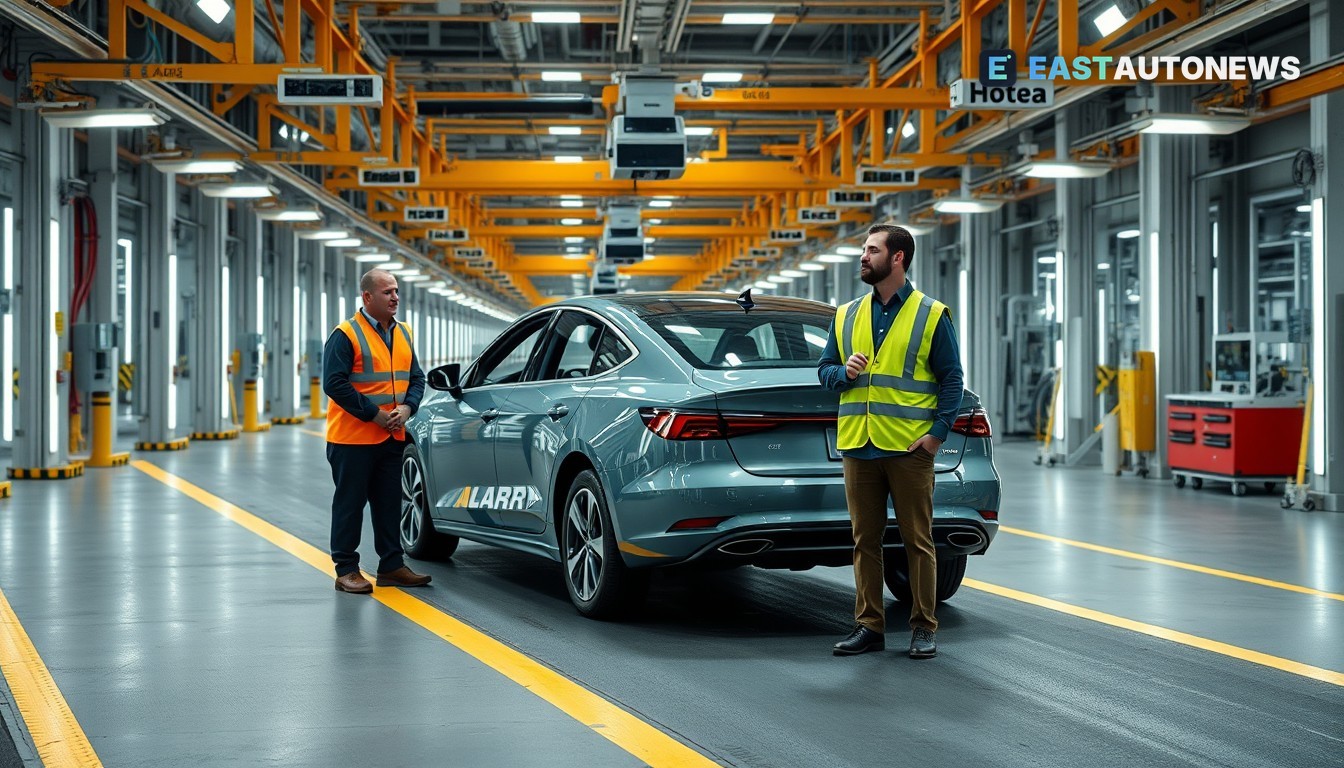
The BMW Group and Swiss software specialist Embotech said their Automated Driving In‑Plant (AFW) system has now completed one million automated vehicle movements across four BMW production sites in Germany and the UK, marking a milestone for AI-driven logistics inside car plants. The companies said the AFW rollout runs 24/7 and handles roughly 3,500 automated vehicle movements per day across the network.
How the system is used in production
AFW was developed in close collaboration between BMW and Embotech and has been scaled from a pilot that began at BMW Plant Dingolfing in 2022 to sites in Leipzig, Regensburg and MINI Plant Oxford. At Oxford alone, BMW reported more than 53,000 automated vehicle moves in the past year. The company plans to continue the rollout, with Plant Spartanburg in the U.S. scheduled as a next site in 2027.
The system uses offboard infrastructure sensors — including LiDAR units mounted along production routes — combined with cloud architecture, motion‑planning software and Embotech’s AI stack to guide newly built cars through defined production and logistics areas. BMW highlights that offboard sensing lets vehicles be moved automatically regardless of their on‑board equipment specification, and that the AFW solution is CE‑certified for safe use in production environments.
Performance and safety claims
Embotech and industry reports say AFW runs continuously with availability above 99.5% and supports different in‑plant use cases, from positioning cars for docking and lift devices to dynamic routing around people, other vehicles and temporary obstacles. The partners describe AFW as a production‑grade application of automated driving technology where perception is primarily provided by infrastructure sensors rather than sensors fitted to each vehicle.
What this means for the market
The million‑movement milestone shows how AI and autonomy are moving beyond research labs into repetitive, high‑throughput industrial tasks where safety, reliability and integration with existing plant controls are critical. For European carmakers and suppliers, AFW demonstrates a route to flexible, software‑driven logistics that can shorten cycle times and reduce manual handling inside plants — benefits BMW says are already being realised at multiple sites.
Suppliers of sensors, edge compute and plant‑level AI software can expect sustained demand as OEMs look to scale similar systems. At the same time, the AFW approach — which centralises perception in plant infrastructure — could lower per‑vehicle hardware costs and simplify integration, potentially making automated in‑plant movements an attractive investment for factories assembling mixed model lines or frequent variant changes.
For Central and Eastern European suppliers and manufacturing hubs that feed into European OEM networks, the trend accelerates requirements for local capabilities in AI engineering, safety certification and systems integration, and may shift some supplier opportunities from hardware‑centric to software and services work.
Sources: BMW Group, Embotech
Partner note: EastAutoNews technology partner DaVinci AI develops AI solutions for the entire automotive industry – from market and dealer analytics to autonomous AI agents and image and video production.