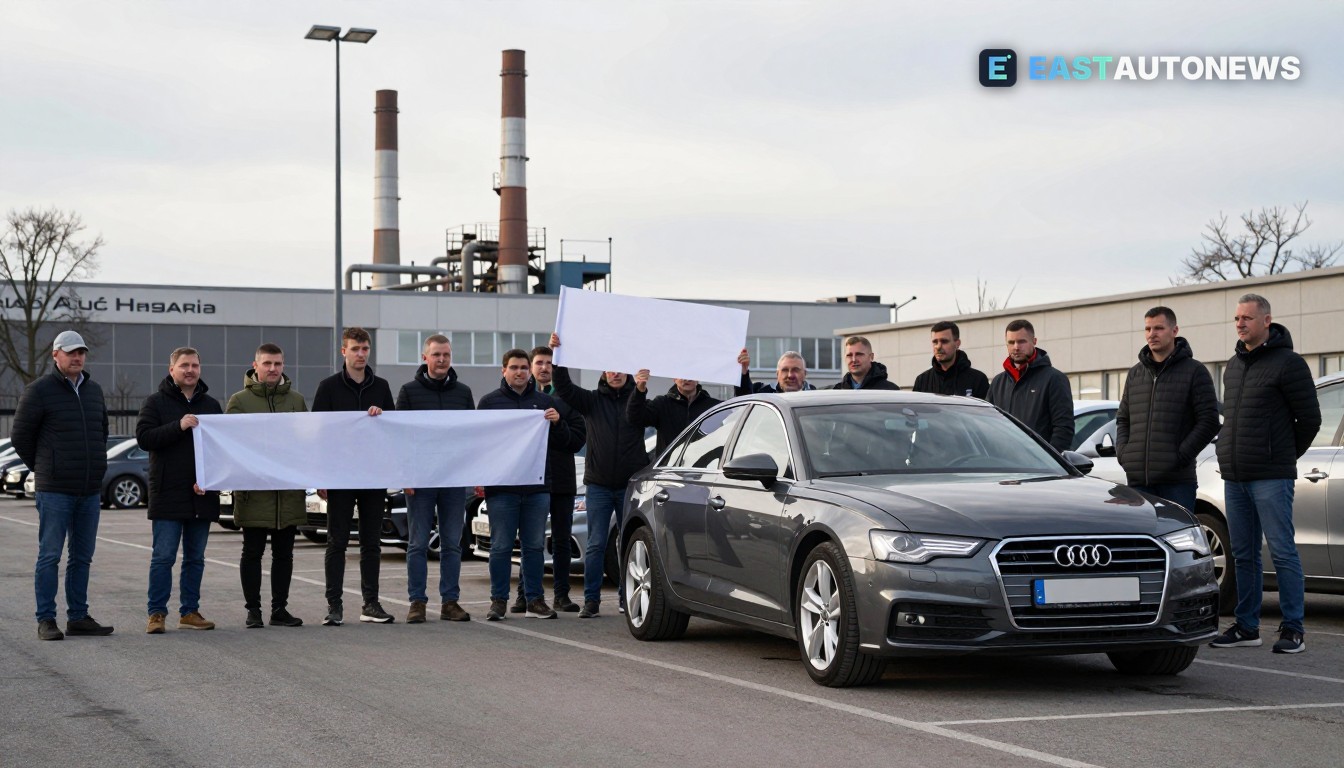
On 9 November 2026 trade unions from across Central Europe gathered outside Audi’s Győr plant in Hungary to press Brussels and national capitals for an industrial policy that protects jobs and directs public investment to weaker regions.
The demonstration, organised by Hungarian metalworkers’ union VASAS and attended by representatives from Poland, Czechia, Slovakia, Slovenia and Germany, was joined by industriAll Europe. Organisers said roughly 200–250 people took part in the rally at the Audi Aréna parking lot, which opened with a minute’s silence for victims of an unrelated attack in Kraków.
Rally demands and the case for regional industrial policy
IndustriAll published a briefing the same day arguing the next EU budget (2028–2034) risks cutting cohesion spending by around 12% in real terms if Brussels moves to merge cohesion funding into 27 national plans—an outcome the unions warned would leave Central and Eastern Europe further behind. The briefing calls for ring‑fenced cohesion funding, an Industrial Accelerator Act targeted at less‑developed and industrial‑transition regions, and binding social conditions on public support so member states do not compete through wage and standards undercutting.
The unions also highlighted the current imbalance in EU industrial support: industriAll noted that Important Projects of Common European Interest (IPCEIs) and crisis state aid have so far been heavily concentrated in core economies, and gave the example that Germany paid out crisis state aid equal to 1.23% of GDP between Russia’s invasion of Ukraine and June 2023—more than twice the EU average (0.58%) and about five times Bulgaria’s level (0.24%).
What this means for the market
The rally underlines an intensifying policy risk for automotive supply chains in Central and Eastern Europe: if cohesion funds are reallocated away from region‑level programmes, smaller suppliers and local R&D projects that underpin vehicle production could face reduced public support for modernisation, electrification and workforce retraining. That would amplify the competitive squeeze suppliers and some OEMs already cite when deciding where to locate investment.
For manufacturers with major CEE operations—such as Audi in Győr—the unions’ demands translate into three near‑term policy items to watch: negotiations over the Commission’s 2028–2034 budget, any proposal for an Industrial Accelerator Act that attaches conditionality to funding, and enforcement of social clauses tied to IPCEIs or national aid. Brussels decisions on these points will shape where and how quickly automakers can secure state‑backed funding for battery lines, factory modernisation and supplier transition programmes.
Speakers at the rally framed the demand in stark terms. IndustriAll General Secretary Judith Kirton‑Darling said: “Workers here in Győr, and across Central and Eastern Europe, build the cars, make critical chemicals, components and machines that keep Europe’s industry running. Too often, they are offered low wages, weak bargaining rights and find themselves at the back of the queue for investment. Enough is enough.” The unions added that coordinated cross‑border action is needed because recent closures and layoffs—cited by organisers as the rationale for moving the protest to Győr—are spreading across the supplier base.
The demonstration is also a prelude to a larger mobilisation organised by industriAll at the European Parliament in Strasbourg on 24 November, a date the union federation says will be used to press MEPs as budget and industrial‑policy files move towards final votes.
Audi models available now on WorldTrader24 →
Sources: IndustriAll Europe, Hungary Today (MTI)