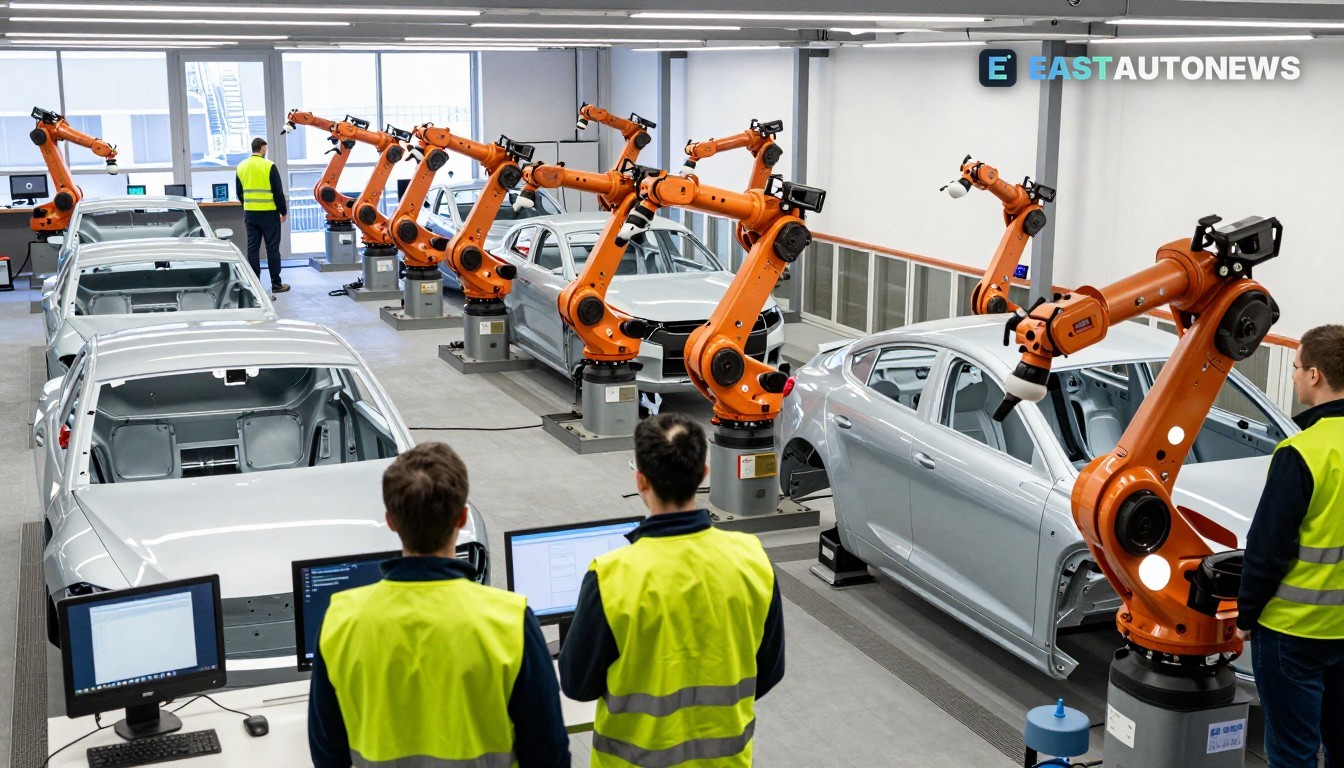
ABB Robotics has announced a major automation order to support BMW Group’s shift to battery‑electric vehicle production. In a press release dated November 11, 2026, ABB said it will supply more than 1,700 large industrial robots to BMW’s new “Neue Klasse” vehicle programme, to be used in body‑shop operations at the automaker’s Munich plant and at Tiexi in China.
The deal and the technology
According to ABB, the robots will carry out demanding, repetitive tasks such as welding, gluing, riveting and assembly. The scope of delivery includes ABB models from the IRB 6720 up to the IRB 6740 and the IRB 7720, with payloads optimised for car body construction and capacities up to 620 kilograms.
All units will be controlled by ABB’s OmniCore platform. ABB says OmniCore increases speed and precision, reduces energy consumption and supports integration of AI, sensor, cloud and edge technologies — a combination the company frames as enabling faster commissioning and richer data exchange across production systems. "With our powerful robots and innovative OmniCore control platform, we are not only delivering maximum precision and efficiency, but also making a measurable contribution to energy savings and the digitalization of manufacturing," Joerg Reger, Automotive Business Line Manager at ABB Robotics, said in the company statement.
Deployment and factory impact
BMW has previously signalled a broad technology refresh for the Neue Klasse that includes tighter integration of software, electronics and new body‑shop processes. The ABB package is aimed at body‑shop tasks where cycle accuracy, repeatability and energy efficiency matter most. Industry reporting notes the order covers installations at BMW’s Munich main plant and at the Tiexi facility in Shenyang, China.
Beyond the immediate body‑shop functions, OmniCore‑controlled robots are designed to enable coordinated data flows for remote diagnostics, simulation and — where implemented — condition monitoring or predictive maintenance. ABB describes the platform as shortening start‑up phases through standardised commissioning tools and supporting features such as energy recovery to lower CO2 intensity during production.
What this means for the market
The contract underlines a wider shift from pilot projects to large‑scale deployment of AI‑ready automation in vehicle manufacturing. For European carmakers and suppliers, the move to OmniCore and similar AI‑capable control systems means factory automation will increasingly generate high‑quality operational data that can be used for quality inspection, digital twins and predictive maintenance.
For Central and Eastern European suppliers and plants, the implications are twofold: first, integrators and systems suppliers in the region may see demand for AI‑capable peripherals, vision systems and software integration services; second, plant operators will need to invest in skills and IT/OT integration to exploit the data these systems produce. Industry reporting frames the ABB‑BMW agreement as part of a broader industrial trend in which automakers scale automation investments that combine robotic hardware with control software and cloud/edge connectivity.
B2B vehicle listings for dealers on WorldTrader24 →
Sources: ABB, MarkLines, Manufacturing Digital
Partner note: EastAutoNews technology partner DaVinci AI develops AI solutions for the entire automotive industry – from market and dealer analytics to autonomous AI agents and image and video production.