Romania’s interim prime minister and energy minister Ilie Bolojan announced a €150 million support programme for standalone battery energy storage systems (BESS) on October 28, 2026, funded from the EU Modernisation Fund. The scheme aims to add at least 2,174 MWh of grid‑connected storage capacity and includes a second line of €76.2 million to retrofit existing generation with batteries, the government guidance shows.
What the government announced
Bolojan said the package is intended to accelerate deployment of grid‑scale batteries that can firm variable renewable generation and provide peak capacity for fast, ultra‑fast and corridor charging. The measure sets a maximum aid intensity of €69,000 per MWh and a per‑company cap of €15 million; applications were to be accepted in a window that ran from September 1 to October 30, 2026, the official guidance states. The scheme’s guidelines had been published in Romania’s Official Gazette on August 17, 2026, and the government reiterated the headline figures during a late‑October announcement. (Sources cited below.)
Why it matters for Central and Eastern Europe’s car industry
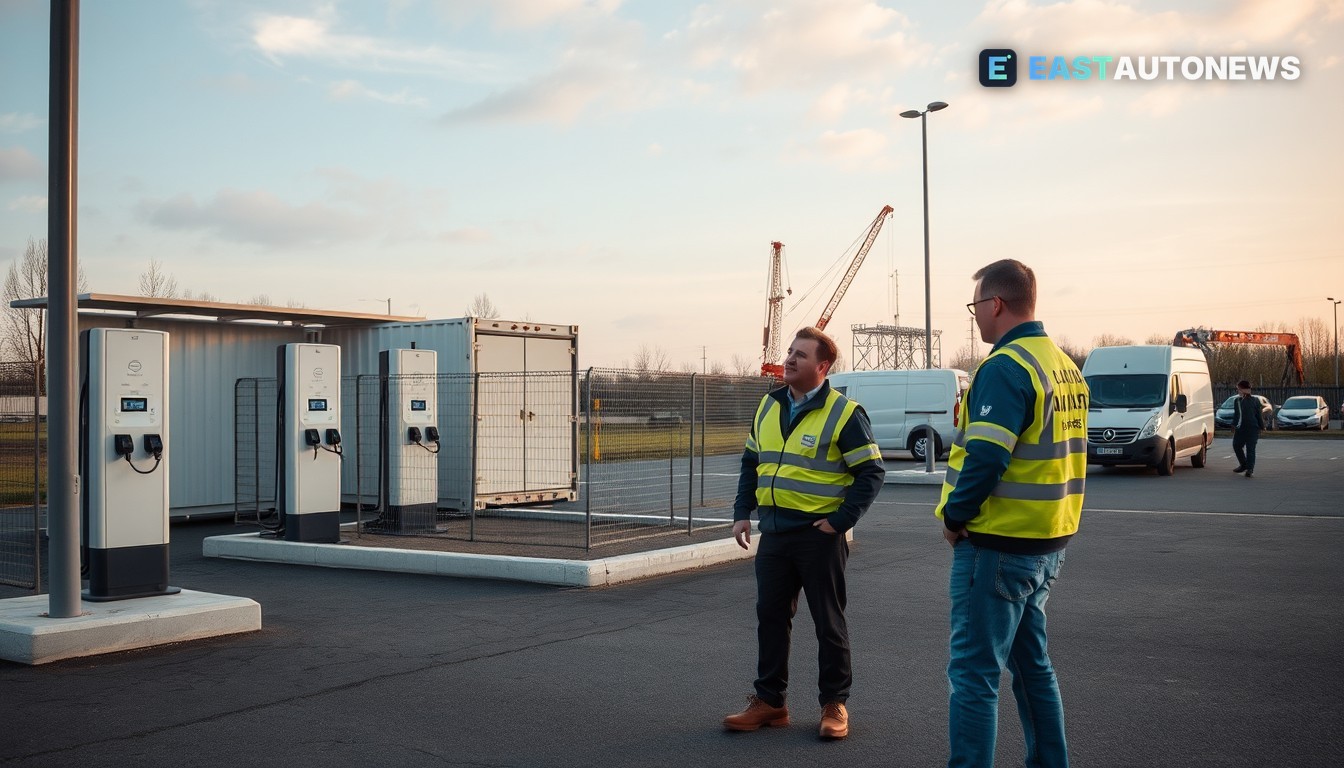
Public‑charging capacity and grid flexibility are among the top limits on rapid EV adoption. A targeted state‑backed push that finances standalone BESS directly connected to the transmission or distribution grid reduces the need for costly local grid reinforcements at motorway hubs and large depot chargers — a practical enabler for operators planning 350 kW+ corridors across Romania and neighbouring markets.
What this means for the market
1) Faster rollout of high‑power charging hubs: By subsidising grid‑side batteries, the scheme lowers the effective cost of attaching multiple ultra‑fast chargers at a single site because batteries can supply peak power without new high‑capacity grid lines.
2) Supply‑chain demand for stationary batteries: The programme creates a near‑term volume signal for battery‑pack integrators, power‑electronics suppliers and systems integrators active in Romania and neighbouring CEE states — firms that supply modules, inverters, thermal management and BOS (balance‑of‑system).
3) Enables logistics electrification: Freight operators and large fleets are more likely to commit to electrification where charging reliability and peak‑power availability improve; grid‑connected BESS can offer the load‑smoothing and availability these users need.
4) Short‑term regulatory clarity: The published caps (€69,000/MWh and €15m per company) and the defined application window provide clarity that helps project developers and investors size bids and structure co‑funding.
Romania’s scheme is not unique in Europe, but its explicit Modernisation Fund backing and stated minimum 2,174 MWh target give the country a material role in regional energy–transport infrastructure build‑out. For carmakers and suppliers targeting CEE, the fund reduces electrification friction: faster charging deployments make EVs more saleable, and a local BESS market supports supplier localisation strategies.
Electric vehicle listings on WorldTrader24 →
Sources: Romania government announcements as reported by Romania Insider and contemporaneous energy‑sector briefings (Romania Official Gazette guidance published Aug 17, 2026; announcement reiterated Oct 28, 2026).