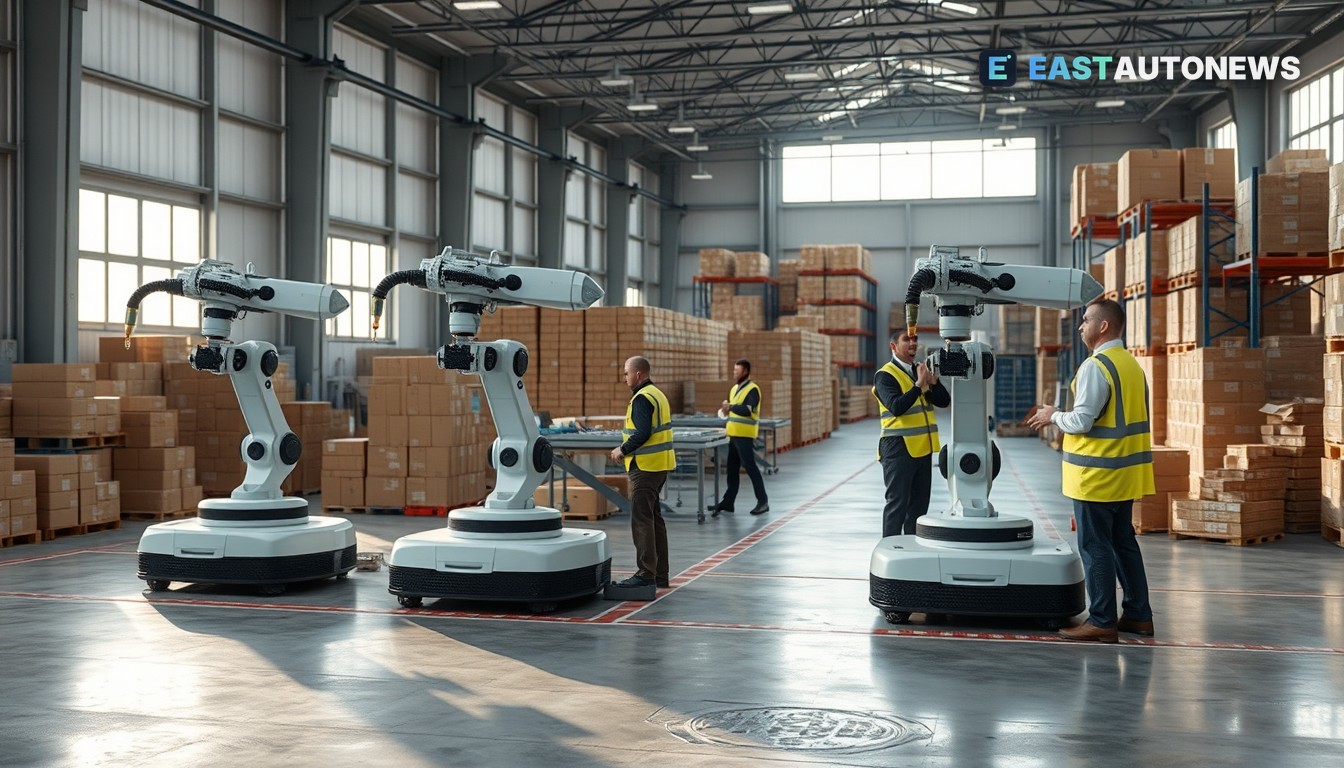
Otto Group and robotics software firm Sereact announced a two‑phase pilot to deploy AI‑controlled dual‑arm robots at an Otto logistics centre in Poland. The programme will start with ten Sereact systems and could scale to a total of 25 robots (an additional 15 units) if initial results meet operational targets, the companies said in a joint announcement published Oct. 28, 2026.
How the system works
Sereact’s robots run on its Cortex “Physical AI” model, which the company says generalises to items the system has not seen before and decides in real time how to grasp, assess condition and route returned goods. Cortex is trained and validated using NVIDIA Isaac Sim, NVIDIA Isaac Lab and NVIDIA Cosmos, and policies are post‑trained and tested on NVIDIA Blackwell GPUs, according to the release.
The project is being delivered under a Robotics‑as‑a‑Service model: Sereact will operate and maintain the systems while on‑site staff shift to supervision, exception handling and final quality checks. The partners say updates and fixes can be brought back from simulation to the live line in days rather than weeks.
What this means for the market
Logistics and parts handling are critical to automotive supply chains in Central and Eastern Europe. Sereact’s announcement notes the company already counts automotive customers — including BMW, Mercedes‑Benz and Daimler Truck — among its references, suggesting the Physical AI stack is already being trialled in sectors adjacent to car manufacturing. That existing customer base underlines why a Polish pilot is relevant to the region’s auto industry.
Otto Group frames the project as part of a broader technology commitment: the company says it has a medium‑term plan to invest €350 million in technology and AI. While this pilot is focused on retail returns, the same pick‑and‑handle challenges — unpredictable items, heterogeneous packaging, and mixed lots — appear in remanufacturing, spare‑parts returns and aftermarket logistics, areas where automotive suppliers and dealers handle high‑volume, variable inventory. That makes the outcome of the trial of direct interest to logistics providers serving CEE car factories and suppliers.
Both partners stress that the pilot will be introduced in stages and that wider rollout will be evaluated only after operational metrics are met. “Our customers expect returns to be simple and fast… Returns are notoriously hard to automate, and Physical AI has the potential to change that,” Martin Umland, Group Vice President Supply Chain Management at Otto Group, said in the announcement. Dr Ralf Gulde, Sereact’s CEO and co‑founder, added: “A robot that only knows yesterday’s catalog is of little use in a returns center. Cortex has to deal with whatever comes out of the next parcel.”
For Central and Eastern Europe — where manufacturing volumes and cross‑border logistics are high and warehouse labour is a recurring constraint — proven, general‑purpose robotic handling could reduce manual handling hours and speed recovery of returned or spare parts. That said, the partners emphasise people remain central to supervision and quality control, and the project is expressly framed as an operational experiment rather than an immediate transformation of automotive logistics networks.
B2B vehicle listings on WorldTrader24 →
Sources: Sereact, GlobeNewswire, EuropaWire, RoboticaGuide