Brussels, 9 November 2026 — The European Commission published its EU Climate Action Progress Report (COM(2026) 601 final) on 9 November 2026, setting out progress on emissions and a policy steer that directly affects the auto industry in Central and Eastern Europe.
What the report says
The report records that registrations of battery-electric passenger cars rose to 1.9 million in 2025 — “around one in six new cars sold in the EU,” — and frames transport as a priority sector for further EU action. It reiterates the Commission’s Automotive Package (first presented in December 2025) and highlights the proposed Regulation on clean corporate vehicles as a tool to accelerate uptake of zero‑ and low‑emission cars and vans by large companies. The Commission also sets out measures to channel industrial support, including an Industrial Decarbonisation Bank and an Investment Booster made available through ETS allowances.
COM(2026) 601 notes that the Automotive Package aims to combine tighter CO2 rules with targeted support for the sector. The report describes the Industrial Decarbonisation Bank proposal and an initial Investment Booster “backed by 400 million ETS allowances worth around EUR 30 billion” to support industrial decarbonisation and clean-tech deployment.
Parliament moves: national plans and 'Made in EU' limits
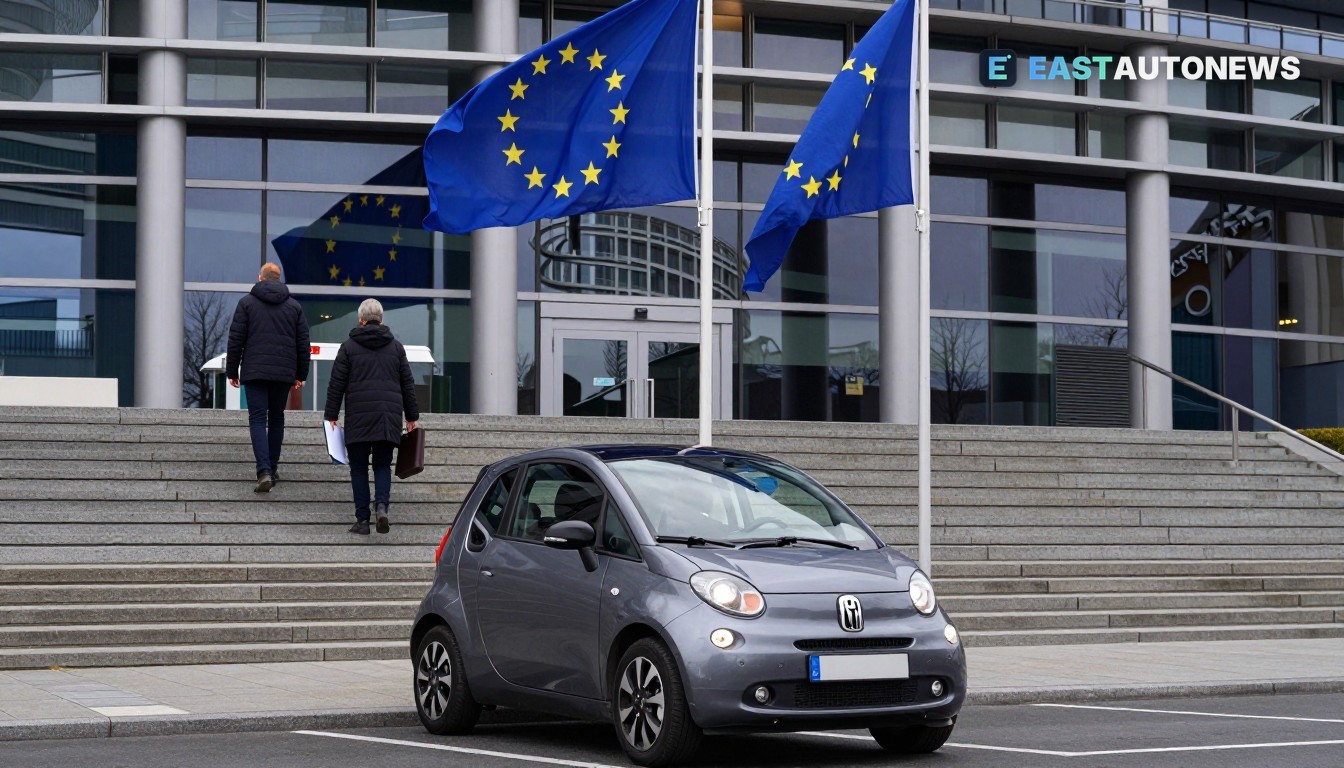
Separately, European Parliament committees preparing the legislature’s position on the clean corporate vehicles file have advanced text that would require Member States to produce national plans and would limit public financial support for corporate vehicle uptake to models considered “made in the European Union.” EP committee records show the committee adopted its report on 4 November 2026, and draft amendments call for Member States to submit national plans by 28 February 2028 and to restrict public financial support to EU‑made zero‑ or low‑emission cars and vans.
What this means for the market
For Central and Eastern Europe the combined Commission report and Parliament momentum matter in three ways. First, the explicit link between public fleet support and EU-made vehicles makes localisation — assembly, component supply, or qualifying value‑content — more valuable. CEE production hubs that already serve European factories and suppliers could win preferential access to subsidy‑driven fleet demand. Second, the Industrial Decarbonisation Bank and ETS‑backed Investment Booster signal new funding routes for factory decarbonisation and for local battery, powertrain and low‑carbon steel projects that suppliers in Slovakia, Poland, Hungary and Romania could tap. Third, corporate fleet rules create predictable corporate EV demand streams (company car and van registrations), which should increase fleet electrification and spur workplace and depot charging rollouts — an opportunity for regional charging and energy players.
However, the measures also raise near‑term compliance questions. Not all vehicles sold to company fleets will meet whatever methodology the Commission and Parliament ultimately adopt to define “made in the EU”; supply chains and rules of origin will be decisive. The report’s data — 1.9 million BEV registrations in 2025 — underlines that the transition is already material but still incomplete, so timing of legal texts and delegated acts will determine how quickly national incentives shift.
WorldTrader24 EU new cars for dealers →
Sources: European Commission (COM(2026) 601 final), EP Votes / EUvahti (Parliament file 2025/0421(COD))