On 30 October 2026 Romania moved a step closer to high‑power freight electrification after Compania Naţională de Administrare a Infrastructurii Rutiere (CNAIR) signed a 30‑year concession for two motorway service areas at kilometre 131 of the A7 (Buzău–Focşani), and PPC Blue România announced a partnership with OSCAR Downstream to install and operate 30 rapid chargers there.
Project details
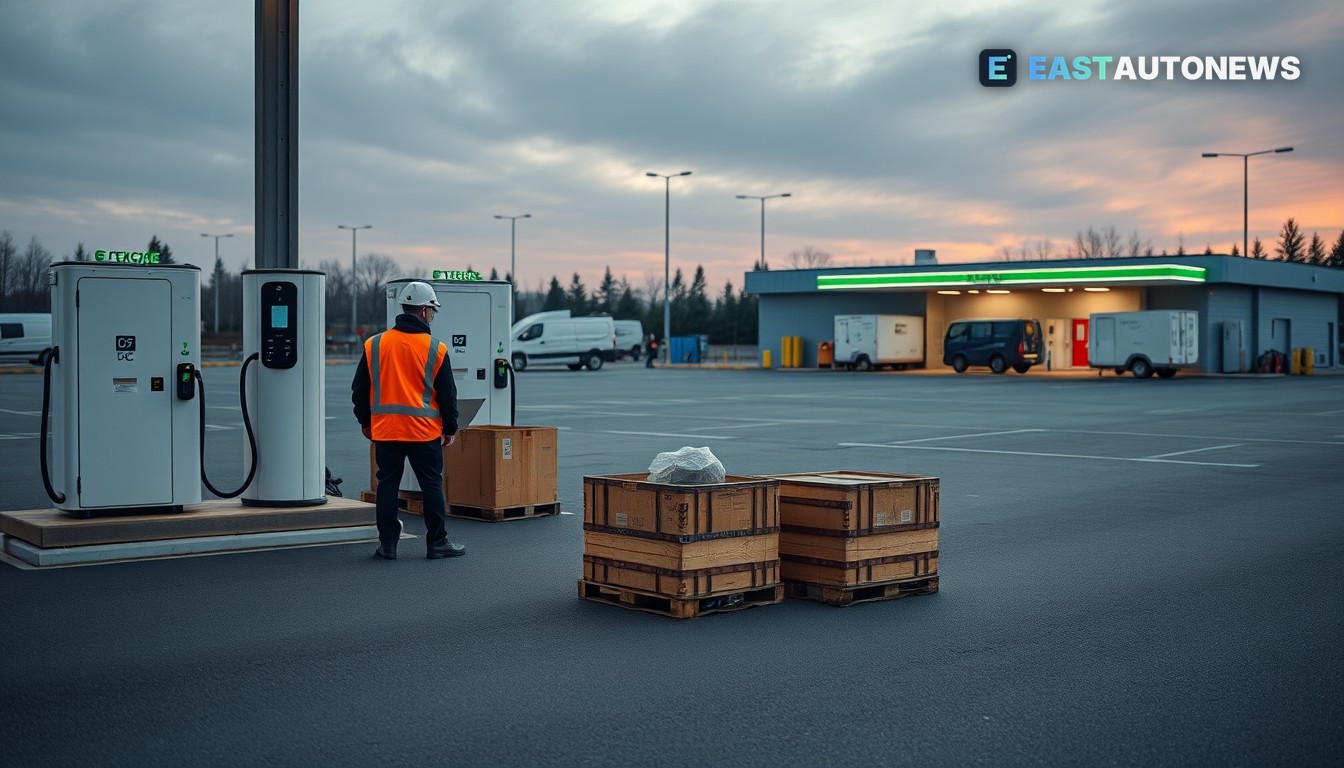
The concession contract was signed on 30 October 2026 and gives OSCAR Downstream 27 months to fit out the two service sites on both carriageways at Milcovul. PPC Blue says it will finance, design, grid‑connect, install and maintain the charging infrastructure for the duration of the concession. The announcement specifies 30 public charging points in total: 16 DC chargers for cars at a minimum of 150 kW each (already installed by the motorway contractor and to be taken over by PPC Blue) and 14 high‑power chargers for trucks and coaches, each rated at a minimum of 350 kW. In each service area at least seven heavy vehicles will be able to charge simultaneously.
CNAIR director general Cristian Pistol flagged the deal in a public post when the concession was signed, noting the 27‑month buildout timetable and that the sites will include the A7’s first secure truck parking areas. "Am semnat astăzi încă un contract de concesiune pentru noi benzinării pe Autostrada Moldovei (A7)! ... Conform contractului, compania OSCAR DOWNSTREAM SRL va amenaja în 27 de luni cele două spaţii de servicii de la km 131," he wrote.
What this means for the market
The Milcovul project is significant because it places high‑power (≥350 kW) chargers for heavy vehicles on a major east‑west corridor in Romania, backed by a long concession and private CPO financing and operations. That combination reduces uptake risk for fleet operators and supports operators planning to electrify long‑haul truck and coach routes to and from Moldova and the Romanian hinterland. It also signals that public motorway concessions are increasingly being used to guarantee long‑term sites for truck charging — a necessary condition for scaling battery‑electric freight.
For suppliers and component makers active in Central and Eastern Europe, the contract creates near‑term demand for high‑power charging hardware, medium‑voltage grid works and depot management systems. For OEMs and fleet managers it reduces one of the key barriers to BEV adoption for heavy vehicles: corridor charging availability. The Milcovul sites will also be among the first motorway truck hubs in Romania designed from the outset for simultaneous multi‑vehicle ultrafast charging.
Implementation risks remain: grid connections at 350 kW per stall require significant local network reinforcement and smart power management; the project timetable allows 27 months for delivery, a period during which permitting and supply lead times will be tested. Still, the combination of a state concession, a local fuel‑retail partner and a specialist CPO operator gives this rollout a practical route to operation rather than a pilot‑only profile.
350 kW truck charging solutions on WorldTrader24 →
Sources: PPC Blue România, CNAIR / News.ro