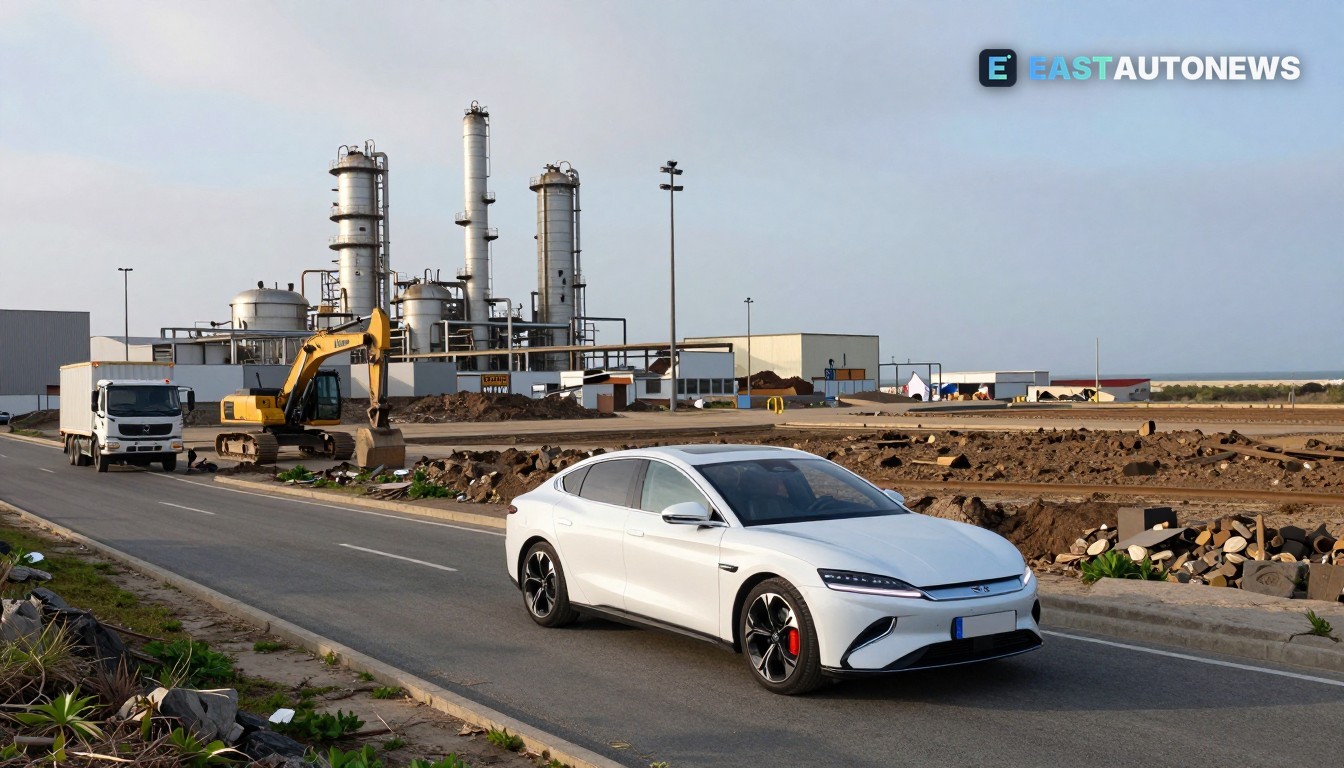
Chinese electric-vehicle group BYD is reportedly in advanced talks with the Portuguese government and the national trade and investment agency AICEP to build a battery manufacturing facility in Matosinhos, near Porto, sources including the Portuguese newspaper Expresso and industry site electrive report.
What the reports say
Expresso first reported on 5 November 2026 that BYD has held several contacts with AICEP and Lisbon about a potential investment on the 240-hectare site that once housed Galp’s Matosinhos refinery. Industry outlets and Portuguese media say Matosinhos is a leading candidate and that the project is already at an advanced stage of discussion.
Portuguese reporting notes local advantages cited in the coverage: the former refinery’s scale and coastal access to the port of Leixões, proximity to planned lithium production in the Barroso region, and Portugal’s high share of renewables — all elements reviewers say make Matosinhos attractive for battery manufacturing.
Portugal’s economy ministry has not published a formal agreement; Economy Minister Manuel Castro Almeida has acknowledged what Portuguese press described as a “fruitful dialogue” with a Chinese automaker but declined to provide further details, according to Portuguese outlets.
What this means for the market
If BYD proceeds, a Matosinhos battery facility would establish a southern‑European manufacturing node for one of the world’s largest EV producers and could be configured as an Iberian hub to serve any future BYD vehicle assembly in Spain, industry reports say.
For Central and Eastern Europe the development matters as market signal rather than immediate fact. A BYD battery hub in Portugal would add capacity inside the EU single market and — if sized for cell production — could shift parts of the sourcing logic that currently attracts battery and cell investment to Hungary, Poland and other CEE locations. That would affect supplier competition for raw materials, skills and logistics, and could alter bargaining levers for incentives and port/rail routing used by carmakers across Europe. (These are directional market effects reported and analysed by industry outlets; no formal BYD investment decision has been announced.)
Timeline and technical scope remain unclear: Portuguese coverage does not confirm whether BYD would build cells, modules or pack assembly, nor does it state investment size, planned capacity or a firm timetable. Reports point to ongoing talks rather than a signed deal.
For suppliers and logistics operators in CEE, the item to watch is confirmation of cell-level production and any declared export footprint: cell-making would be a more material change to Europe’s battery geography than pack assembly alone. Until BYD or Portuguese authorities make an official announcement, market actors should treat the current reports as a credible lead that remains subject to formal agreement and permitting.
Electric vehicle listings on WorldTrader24 →
Sources: Expresso, electrive