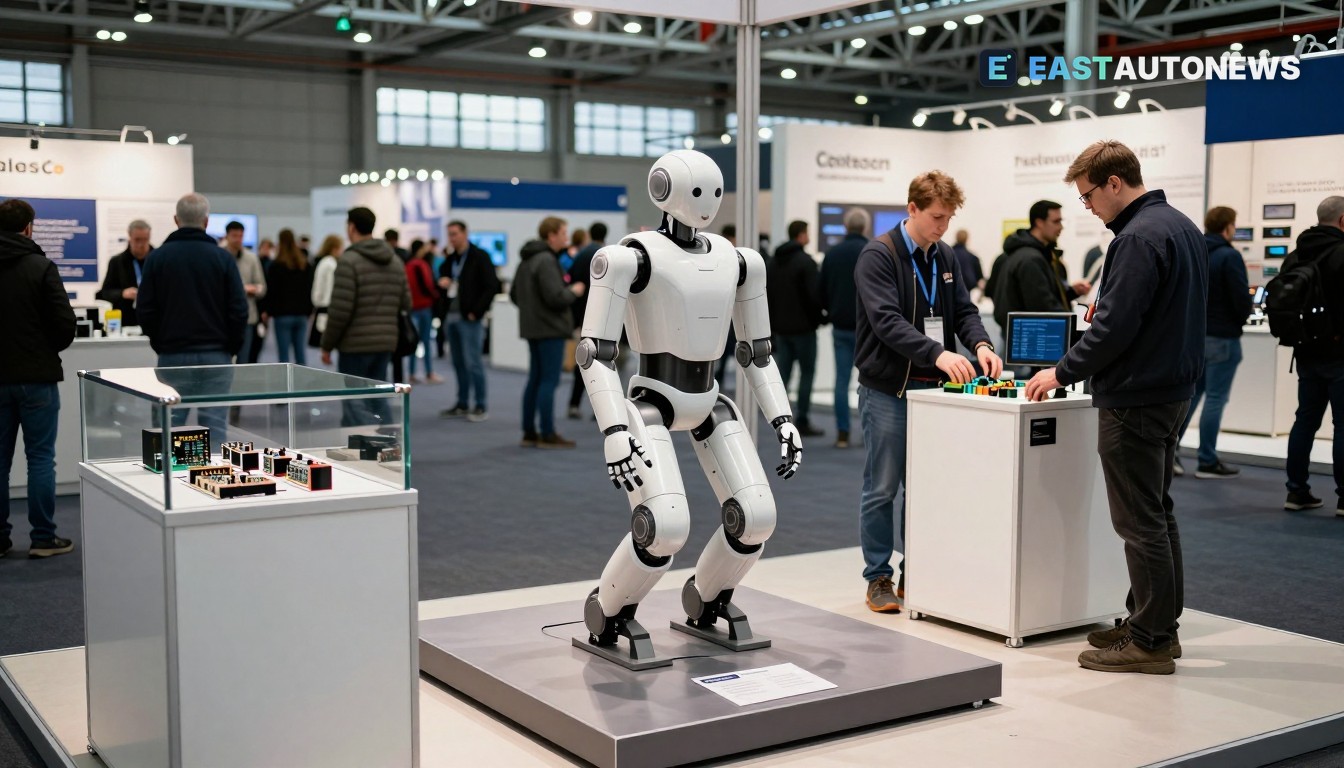
Elmos Semiconductor SE and Chinese robotics partner AGIBOT presented a humanoid-robot demonstration at electronica in Munich on November 11, 2026, showing how chips originally designed for automotive functions can be deployed in robotics applications. The company said the demo highlights motor control, sensing, communications and power-management integrated circuits that are already proven in cars.
What Elmos showed
Elmos said the exhibit used its sensor ICs (for capacitive touch, proximity, PIR and ultrasonic sensing), motor-control and eFuse power-protection devices, and network ICs — and that a single humanoid robot could integrate “more than 120 Elmos ICs” for motion, sensing, power and connectivity. The company also highlighted its QRNG (quantum random-number generator) as a hardware building block for cryptographic protection of edge communications. The presentation took place at electronica 2026 (Hall C3, Booth 141).
Why it matters for carmakers in Central and Eastern Europe
Automotive-grade analog and mixed-signal semiconductors are critical inputs for EV power electronics, motor control, body electronics and safety systems. Elmos is an established supplier to European OEMs and tier suppliers; its push into adjacent markets such as robotics underscores continued demand for the same classes of chips that vehicle plants across Central and Eastern Europe rely on. That matters because competing non-automotive demand (robotics, industrial automation, data-centre edge devices) can influence capacity planning, lead times and prioritisation at foundries and test houses used by European automotive suppliers.
What this means for the market
Short term: the electronica demo is a marketing and product-readiness signal rather than a shipping-volume announcement — Elmos’ press material does not claim new automotive production ramps tied to the demo. Still, the show points to rising cross-sector competition for automotive-qualified chips (analog/mixed-signal, motor drivers, sensor front-ends and secure network devices). Carmakers and suppliers in the CEE region should monitor allocation risk for these chip families when negotiating contracts and planning production windows.
Medium term: if semiconductor suppliers secure design wins outside automotive — for robotics, industrial or consumer products — foundry and test capacity decisions may shift. That could lengthen qualification cycles for alternative suppliers and increase the premium on automotive-qualified inventory, with knock‑on effects for EV power‑electronics timelines and supplier sourcing strategies in Poland, the Czech Republic, Slovakia, Hungary and Romania.
Elmos’ move also reinforces the strategic logic behind EU and national efforts to bolster semiconductor supply and local testing capacity: automotive customers value suppliers that can guarantee long-term availability and automotive‑grade qualification. Monitoring design‑win flows and foundry capacity for analog and mixed‑signal parts will be especially important for procurement teams at OEMs and CEE‑based suppliers.
WorldTrader24 B2B Fahrzeugmarkt für Händler →
Sources: Elmos Semiconductor SE press release (EQS / Webdisclosure), PressReleaseFeed / PresseBox.