The EU’s Batteries Regulation (Regulation (EU) 2023/1542) moved from framework to implementation in 2026, with the Digital Product Passport (DPP) infrastructure coming online and a string of phased legal obligations now carrying firm dates. The central legal milestones relevant to Romanian industry are: the EU DPP Registry became operational on 20 July 2026; a battery passport and QR‑code requirement for EV and industrial batteries takes effect on 18 February 2027; and the Regulation’s supply‑chain due‑diligence obligations apply from 18 August 2027 (the latter was postponed from 2025 by Regulation (EU) 2025/1561).
What the new rules require — and when
From 18 February 2027, every EV battery, every light‑means‑of‑transport battery and industrial batteries >2 kWh must have a battery passport and a QR code pointing to a unique identifier; the Commission’s July 2026 guidance maps the Annex‑XIII data fields and clarifies which fields are mandatory, optional or held back pending implementing acts. The guidance stresses that passport data will include manufacturing location, unique identifiers, chemistry, recycled‑content figures and selected circularity fields — though some carbon‑footprint and responsible‑sourcing fields were marked as not to be filled/displayed for Feb. 2027 pending formats. Preparing the passport therefore requires data flows from cell makers through pack integrators to OEMs and to the central registry.
Romania’s storage and grid projects: a pipeline already in place
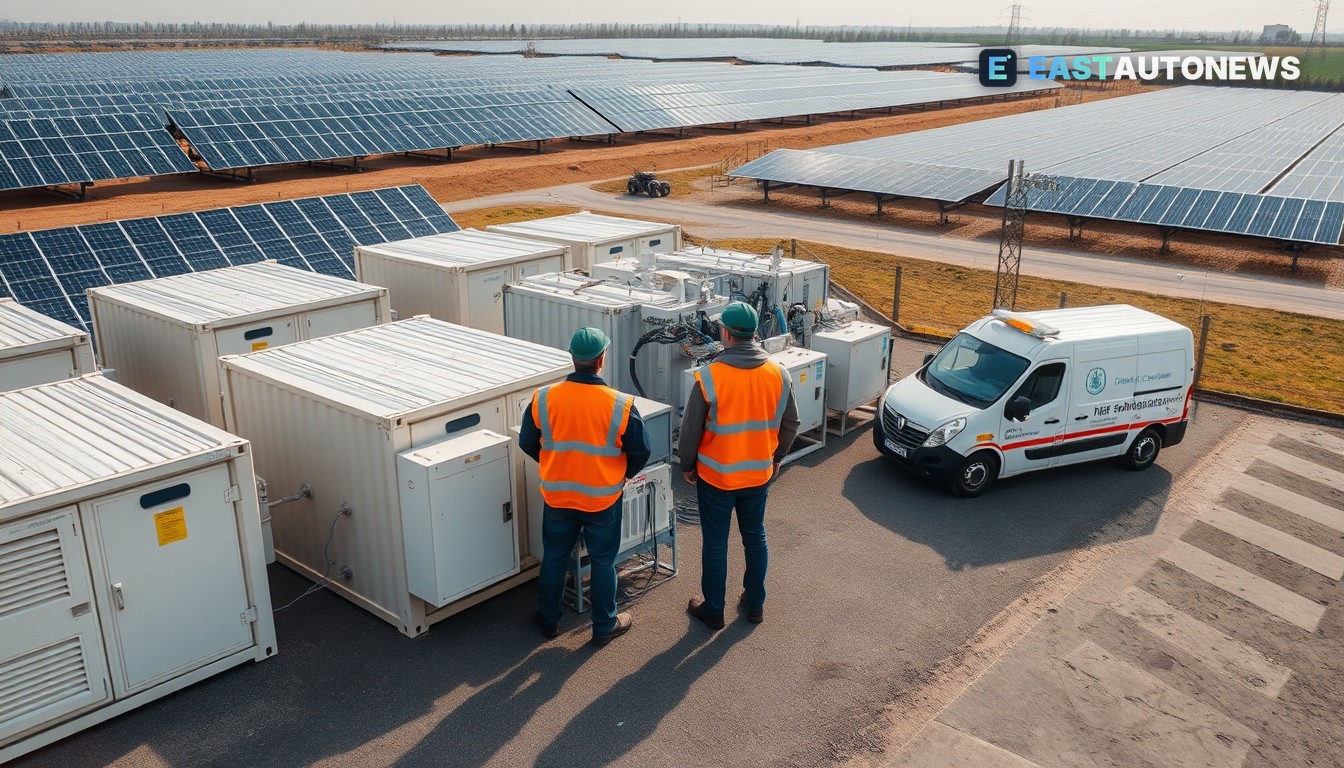
Romania’s utility‑scale battery projects are advancing now, and several reached late construction or grid‑connection stages in 2025–26. Visual Fan / Allview reported two completed BESS builds entering grid‑connection certification in Q1 2026: Teiuș (about 116.96 MWh) and Toplița (65 MWh, using Trina Storage hardware), both described as in the phase of obtaining the national grid connection certificate. Those systems will generally be classed as industrial batteries under the Batteries Regulation, and so they fall within passport and QR‑code obligations from Feb. 18, 2027.
Developers with larger portfolios also secured technical connection permits: Finnish developer Korkia reported that transmission‑level grid‑connection permits (Avize Tehnice de Racordare) were secured for its Romanian Alexandria and Iron Gates portfolios in 2026, marking routes to build‑ready status for several hundred megawatts of hybrid solar + BESS projects. Those permits anchor the reality that grid‑side storage and charging projects will need operational compliance with the EU passport and registry model.