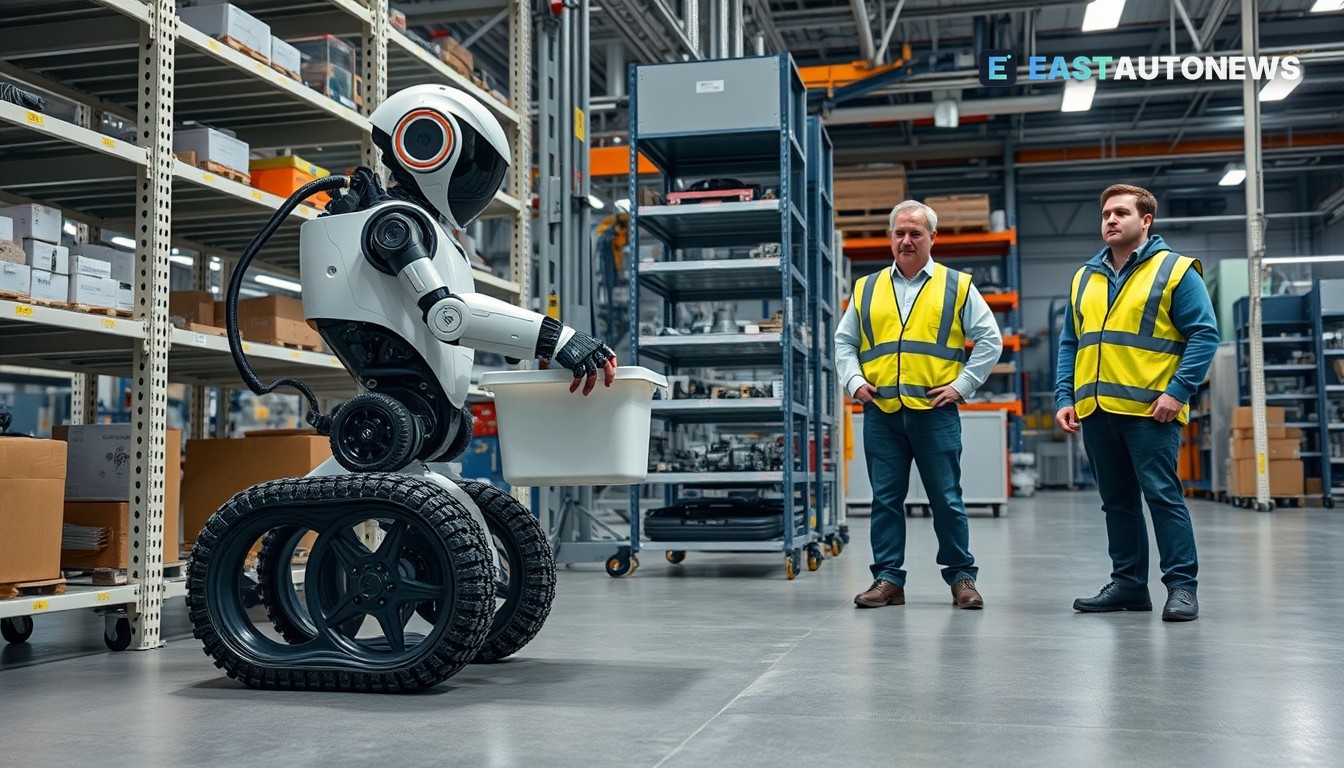
Audi has started a proof‑of‑concept using mobile humanoid robots to pick and sequence parts at its Ingolstadt production lab, the company and partners said on Oct. 21, 2026. The trial brings together Audi, Munich-based Agile Robots, Dassault Systèmes and NVIDIA to test whether AI‑driven humanoids can handle the complex, high‑variant picking that feeds final assembly.
The test and the technology
At the Production Lab in Ingolstadt, Agile Robots’ mobile humanoid systems take components from material containers and place them in the exact order required by the final assembly line — a process Audi says involves around one million picks every day. Partners build a virtual twin of the logistics area using Dassault Systèmes’ DELMIA on the 3DEXPERIENCE platform and accelerate simulation with NVIDIA Omniverse libraries before any robot is deployed on the real floor. The project is already under way, the companies said, but provided no timetable for series rollout, robot counts or financial terms.
Agile Robots also unveiled a compact research humanoid, the Agile ONE SN, at NVIDIA’s GTC Berlin event on Oct. 21. The ONE SN is preconfigured with NVIDIA Isaac GR00T software and NVIDIA Jetson Thor edge compute; Agile Robots lists the platform’s physical specs — about 1.4 m tall, roughly 40–43 kg, with multi‑view sensing, tactile five‑finger hands and roughly 31 degrees of freedom in the body — and says the research platform is intended to speed lab‑to‑line development of manipulation skills.
Timeline and next steps
The partners say they will use the virtual twin to test feasibility, timings, ergonomics and safety before moving robots into operational zones. Dassault Systèmes’ virtual companion LEO is cited as a tool to shorten engineering work from months to days during validation. NVIDIA described the Agile ONE SN as a reference humanoid for research, with availability scheduled for early 2027; Agile Robots said skills developed on the compact platform can transfer to a full‑size industrial Agile ONE when ready.
Что это означает для рынка
For European carmakers and suppliers the trial is significant because parts sequencing has long resisted fixed automation: variants, semi‑rigid parts and mixed containers make reliable, high‑volume picking difficult. Audi’s approach — combining virtual twins, simulation libraries and an off‑the‑shelf humanoid reference design — shows a route that can reduce physical rework on the factory floor and preserve existing racking and material flows if the robots reach the required reliability and safety levels. That path matters for plants across Germany, Central and Eastern Europe where re‑tooling whole lines is costly and downtime risks are high. The project also underscores growing supplier and tooling demand: simulation, perception systems, tactile grippers and safety stacks are now central procurement items, not optional extras.
Still, the announcement is a laboratory‑level proof‑of‑concept rather than an industrial roll‑out. The partners did not disclose performance metrics, hourly pick rates for the robots, or a schedule for moving from the Production Lab to a live sequencing line. Wider adoption in European plants will depend on demonstrable throughput gains, clear safety certification, integration costs and how quickly humanoid suppliers can scale production of validated units.
Sources: Audi, NVIDIA Newsroom, Agile Robots
Примечание партнёра: EastAutoNews technology partner DaVinci AI develops AI solutions for the entire automotive industry – from market and dealer analytics to autonomous AI agents and image and video production.