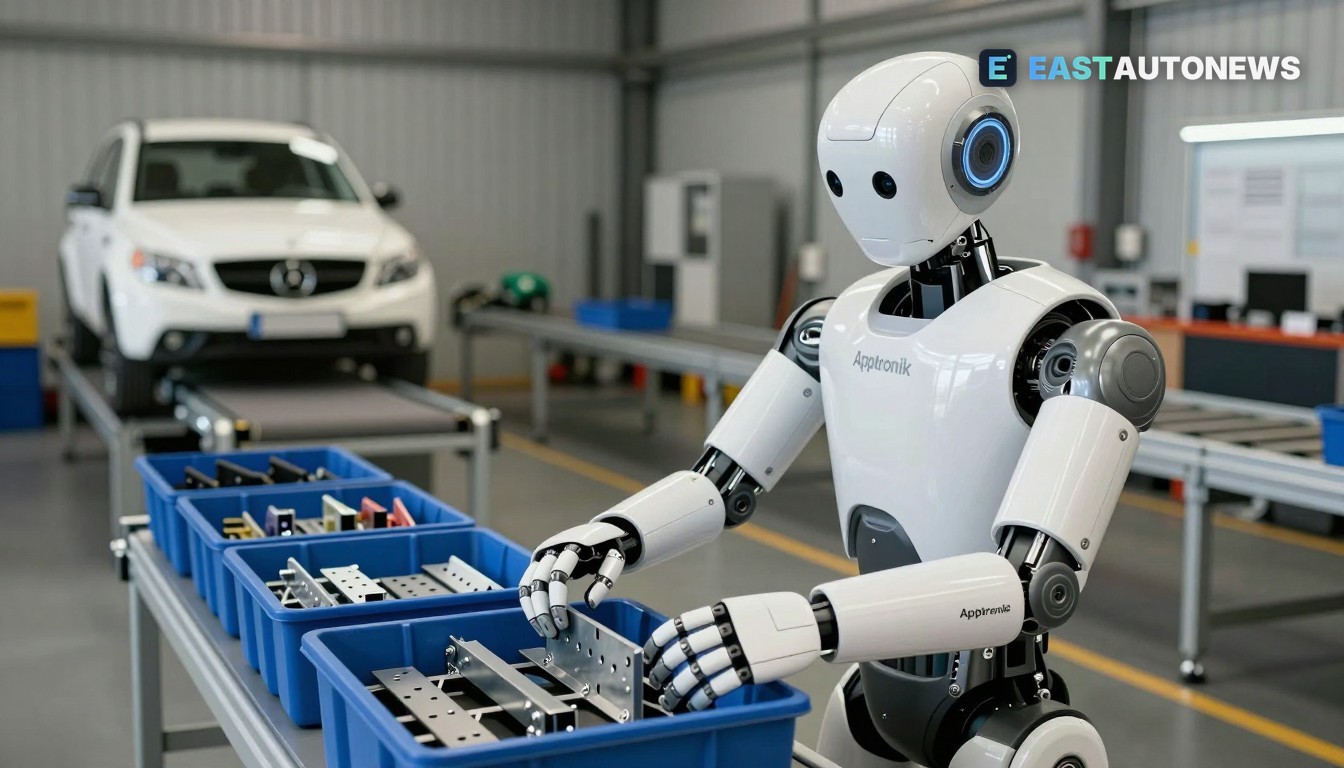
GXO Logistics and humanoid‑robot maker Apptronik announced on 12 November 2026 that they have signed a Letter of Intent (LOI) to expand joint trials of Apptronik’s Apollo humanoid and to develop a commercial Robotics‑as‑a‑Service (RaaS) framework. The companies said expanded operational trials will begin in 2027 and, subject to agreed performance, safety and operational KPIs, they intend to progress toward a global rollout of up to 1,000 Apollo robots over the next four years. (GXO GlobeNewswire, 12 Nov 2026).
What the LOI says
The GXO press release (datelined Greenwich, Conn., 12 Nov 2026) describes the agreement as an expansion of a partnership that began with earlier proofs of concept. The planned trials will cover typical warehouse workflows — goods‑to‑person and person‑to‑goods picking, case and tote movement, packing and sortation — and the firms expect initial commercial deployments to start in North America in late 2027, with wider roll‑out only if the robots meet agreed KPIs. The release frames the commercial offer as a Robotics‑as‑a‑Service model rather than an outright purchase order. (GXO GlobeNewswire, 12 Nov 2026).
Safety, scope and company claims
GXO’s announcement repeats that the LOI is conditional: it is not a firm order but a framework to scale trials into a potential global deployment if technical and safety targets are achieved. The release quotes GXO CEO Patrick Kelleher saying, in part, “Humanoid robots are the latest evolution of intelligent automation.” Apptronik and GXO also say the companies have run tens of logistics tasks in live evaluations and at Apptronik’s Robot Park during prior work to develop autonomy and data collection. (GXO GlobeNewswire; company statements, 12 Nov 2026).
What this means for the market
For Central and Eastern Europe the deal matters because contract logistics and automated fulfilment are already critical to regional supply chains that serve carmakers and suppliers. GXO is a global contract‑logistics operator with established European operations and a track record in automated warehousing; scaling humanoid deployments through a RaaS model would add a new form of physical AI to existing automation toolkits used in parts sequencing, aftermarket logistics and component distribution. If pilots meet the stated KPIs and the RaaS model proves commercially viable, those services could be offered to OEMs and tier‑suppliers that use third‑party logistics across CEE — but the timeline, sites and volumes for any European roll‑out remain unspecified in the LOI and contingent on trial results. (GXO press release; company profile).
Operationally, humanoid robots promise flexibility — the ability to perform many different manual tasks without bespoke conveyors or retooling — and that appeals where plants and distribution centres handle varied components and sequencing work. Equally, the LOI underlines the many open questions that matter to manufacturers and suppliers in CEE: safety certification, cost per task under a RaaS contract, the ratio of robot to human labour most productive in mixed teams, and who bears integration and data‑ownership costs. The press release stresses those commercial and safety benchmarks will determine any large‑scale roll‑out. (GXO GlobeNewswire, 12 Nov 2026).
Available vehicles now on WorldTrader24 →
Sources: GXO Logistics (GlobeNewswire), Apptronik