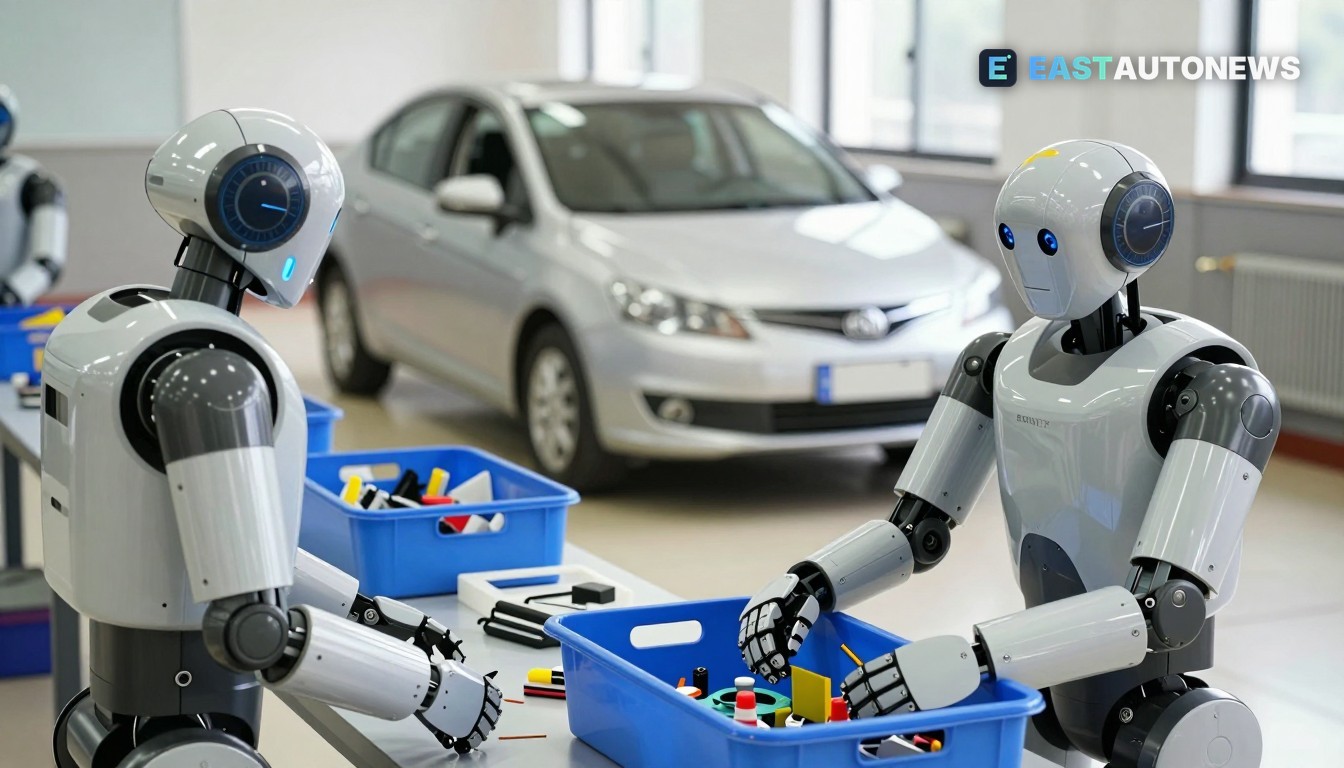
Google DeepMind on 10 November 2026 unveiled Gemini Robotics 2.5 and said the model helped Apptronik’s Apollo 2 humanoid robots perform automotive kitting on active Mercedes‑Benz production lines in Kecskemét, Hungary, and Sindelfingen, Germany. DeepMind reported a 96% success rate for the pilot, describing the work as a proof‑of‑concept rather than a commercial deployment.
The Kecskemét pilot
DeepMind says the task involved autonomous kitting — picking metal brackets from bulk bins and placing them into sequencing containers in the exact order required by the assembly process. The company described using an embodied reasoning model (Gemini Robotics ER) to track workflow and the Gemini Robotics 2.5 actions model to control the robot’s hands and arms. DeepMind’s post names Apptronik and Mercedes‑Benz as partners for the trial.
Apptronik co‑founder and CEO Jeff Cardenas is quoted on DeepMind’s blog: “This is what we built Apollo for: useful work alongside people in real industrial settings. Pairing Apollo 2 with Gemini Robotics, we saw the models improve dramatically in just a few weeks of post‑training and carry over to Mercedes‑Benz production with very little drop‑off.”
DeepMind also highlighted safety and steerability improvements: inference‑time reasoning to avoid hazards raised safe task completion around obstacles by 33% and around nearby people by 43%, and the team released an open safety benchmark (ASIMOV‑Jailbreak) to evaluate adversarial prompts. The company says Gemini Robotics 2.5 is rolling out to robotics partners rather than being generally available.
Context and expert take
Independent reporting and industry commentary note the significance — but also the caveats — of the result. Coverage points out DeepMind’s 96% figure comes from a pilot on specific kitting tasks and that the company has not published raw trial counts, cycle‑time data or a formal technical report alongside the announcement. DeepMind staff concede closing the final gap to human‑level reliability for every application remains challenging.
What this means for the market
For Central and Eastern European carmakers and suppliers, the pilot is notable because it places advanced embodied AI and humanoid robotics directly onto an active line at a major Hungarian plant. If general‑purpose robot models can reliably perform repetitive and ergonomically taxing tasks such as kitting, regional factories could redeploy human staff to higher‑value tasks, reduce labour constraints on shift patterns, and raise throughput for labour‑intensive prep work — provided commercial systems reach sustained industrial reliability. The announcement may also accelerate supplier interest in robotics integrators, local robot training data services, and on‑site safety validation processes.
However, the rollout remains a partner‑only phase and DeepMind’s blog and industry reporting both stress that the model is not a finished plug‑and‑play factory product. Automakers in the region will weigh the pilot’s promise against the need for traceable failure data, cycle‑time economics and occupational‑safety certification before large‑scale adoption.
Mercedes Benz offers on WorldTrader24 →
Sources: Google DeepMind, Ars Technica, Association for Advancing Automation