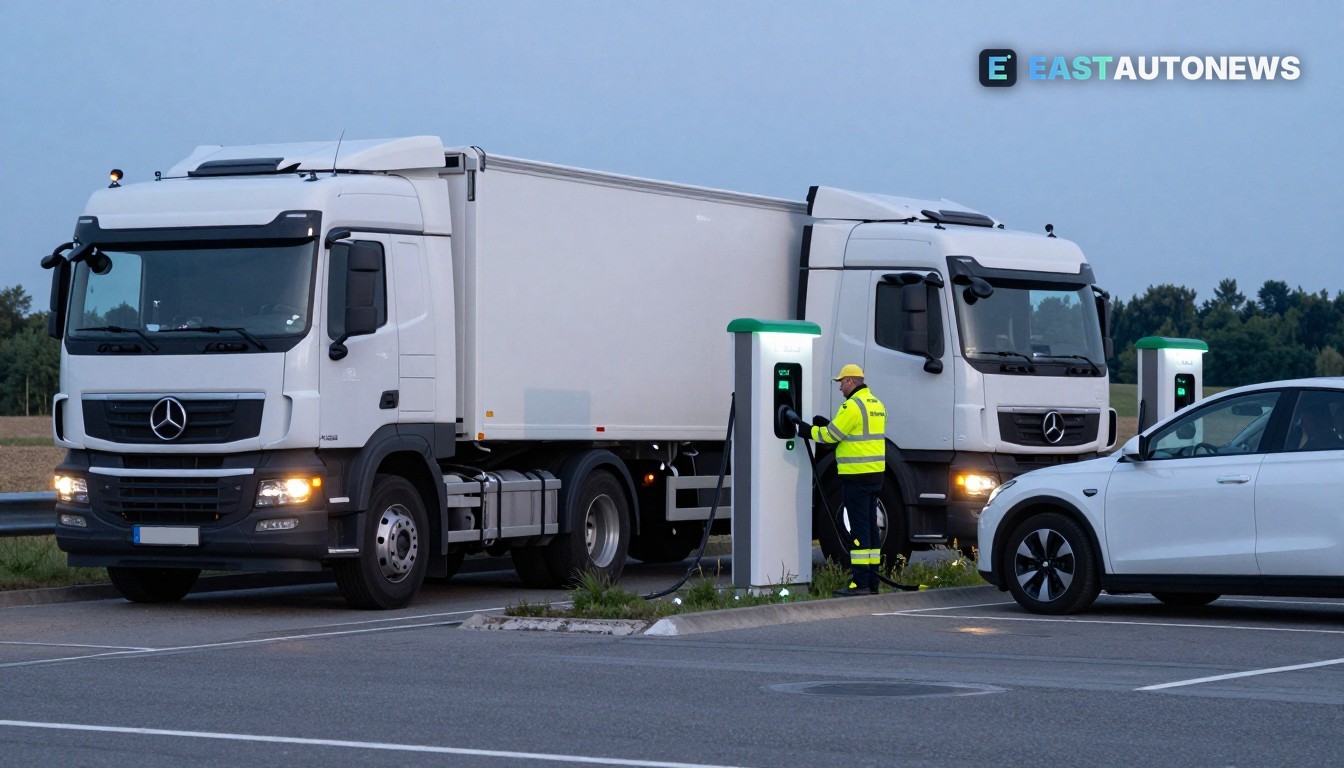
Poland took a practical step toward electric long‑haul freight this week as ORLEN highlighted its first public Megawatt Charging System (MCS) installation on the A1 motorway and a new high‑power hub on the S19 corridor. ORLEN said in its November 4, 2026 corporate update that “ORLEN Charge has opened Poland’s first public truck charging station using the Megawatt Charging System (MCS).”
The rollout
The MCS bays are installed at the MOP Stobiecko Szlacheckie rest areas on the A1 (both east and west sides), with a second new hub reported at Sobieszczany‑Kolonia on the S19 corridor south of Lublin. Local press and industry sites say the Stobiecko installation was first put into public service in late August and is visible in ORLEN’s app and public registries.
ORLEN’s November statement described the MCS site as capable of delivering “up to 1.5 MW” of power for heavy vehicles, marking it as one of the earliest public megawatt‑class charging points in Central Europe. At present some site displays and operator apps report the active MCS output at around 1.2 MW while the location’s electrical configuration is prepared to support 1.5 MW, reflecting how commissioning and staged activation affect published peak figures.
What this means for the market
Megawatt‑class chargers are a technical and commercial pivot for regional logistics. Trucks with large battery packs need far higher peak power than passenger cars to refill useful range during legally mandated driver breaks; MCS and similarly powerful chargers are designed to meet that need. Building these hubs also exposes the grid and site‑planning challenges that accompany megawatt charging: high instantaneous power often requires onsite buffering (battery energy storage) or grid reinforcements to avoid prohibitive connection costs.
For Central and Eastern Europe, ORLEN’s deployment matters for two reasons. First, it places public megawatt capability on an important north–south/east–west corridor (A1 and S19), supporting cross‑border freight electrification and reducing range‑anxiety for operators choosing battery trucks. Second, by combining multi‑level hubs (400–600 kW for cars and 1.2–1.5 MW MCS for trucks) ORLEN signals a hub strategy that consolidates passenger and heavy‑duty charging at motorway service points — the model most logistics fleets will need to scale. ORLEN also reported its wider charging footprint and investment plans in the same November statement, underlining the company’s corridor‑focused expansion.
Implementation questions remain: real‑world MCS utilisation, charging‑session management when multiple high‑power vehicles call on the same site, and the pace of grid upgrades or battery buffering that operators will accept commercially. But for fleet buyers and suppliers across CEE, the MOP Stobiecko Szlacheckie and the new S19 hub provide a first public reference point for planning routes and depot strategies around megawatt charging.
WorldTrader24 B2B-Fahrzeugmarkt für Händler →
Sources: ORLEN, LovEV, HowToStoreElectricity