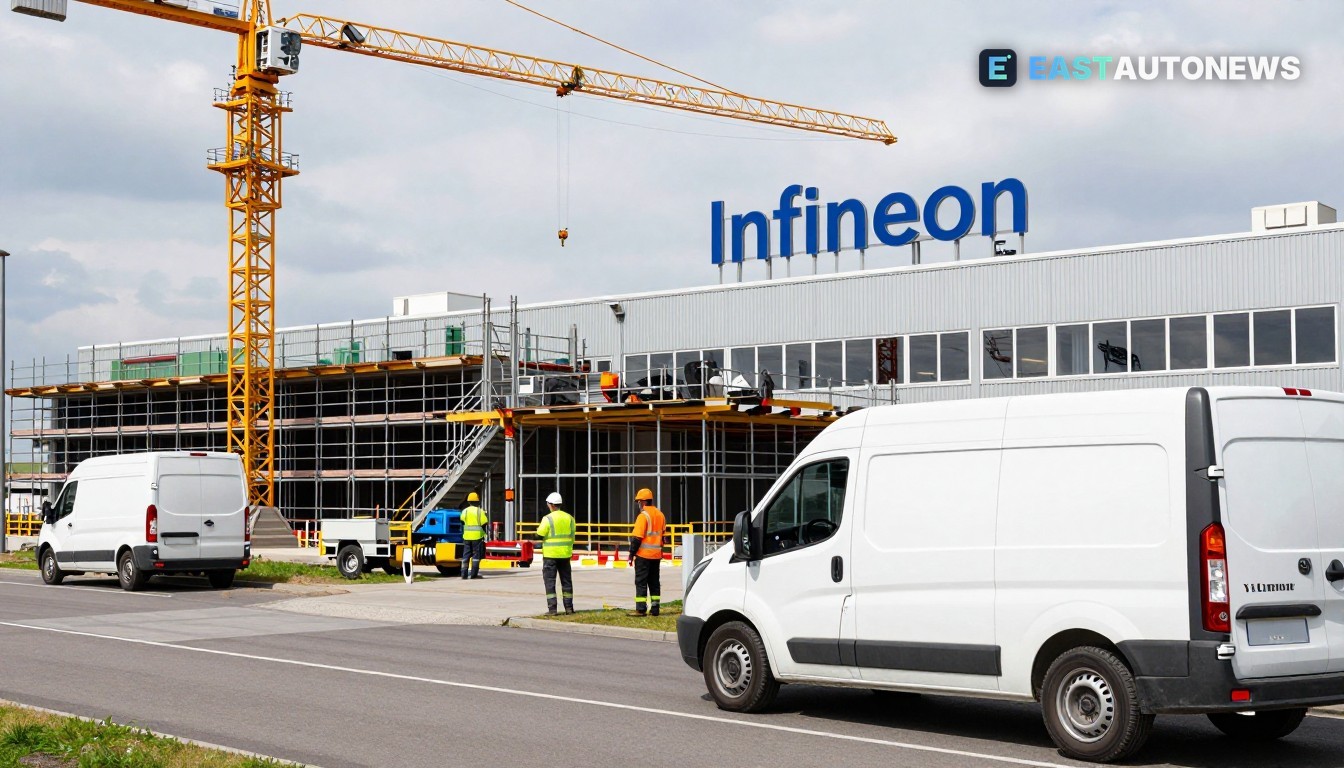
German chipmaker Infineon said customers must commit to orders before it will expand semiconductor capacity further, a rare public appeal that underlines how makers of vehicle power electronics and other suppliers are wrestling with the economics of new fabs in Europe. The company’s chief executive Jochen Hanebeck made the point at an industry event on Nov. 9–10, 2026, saying customer commitments are needed to justify the financial risk of further expansion.
Villach GaN fab: scale, timetable and public support
Infineon last month announced plans to invest around €1.1 billion to convert and expand its Villach, Austria, site into the world’s first high-volume 300‑mm gallium‑nitride (GaN) power‑semiconductor manufacturing facility. Production is scheduled to start by the end of 2027, and the project is backed by a €319 million allocation under the European Chips Act, the company said on Oct. 27, 2026. The Villach expansion is being pitched as essential for power‑efficient chips used in AI data centres, energy infrastructure and e‑mobility.
Those moves follow Infineon’s opening in July 2026 of a €5 billion Smart Power Fab in Dresden — a major capacity addition the company says doubled its local manufacturing scale — showing Infineon is already investing heavily in European production but wants demand visibility before doing more.
What this means for the market
For carmakers and Tier‑1 suppliers in Central and Eastern Europe the message is unambiguous: more locally produced power semiconductors — silicon carbide (SiC) and GaN among them — are technically coming, but OEMs and large Tier‑1s will need to turn those intentions into purchase commitments if they want capacity to expand faster. Power chips are critical for inverters, on‑board chargers and fast chargers, and Europe’s new GaN capacity is explicitly aimed at easing supply for those applications.
Hanebeck also warned that Europe still faces an uneven global playing field for chip investment and that public funding is necessary to attract fabs — a point that underpinned both the Dresden and Villach projects. For CEE suppliers that build or integrate power‑electronics modules, a reliable European source of GaN/SiC could cut lead times and freight cost, but it will only follow if large buyers accept multi‑year commitments or take other demand‑aggregation steps.
Short‑term the Villach investment should reassure vehicle electrification projects that Europe intends to scale relevant chip supply. But Infineon’s appeal is a reminder that capital‑intensive fabs require sales certainty — and that OEM procurement strategies will influence where and how quickly new capacity appears.
Electric vehicle listings on WorldTrader24 →
Sources: Reuters, Infineon Technologies