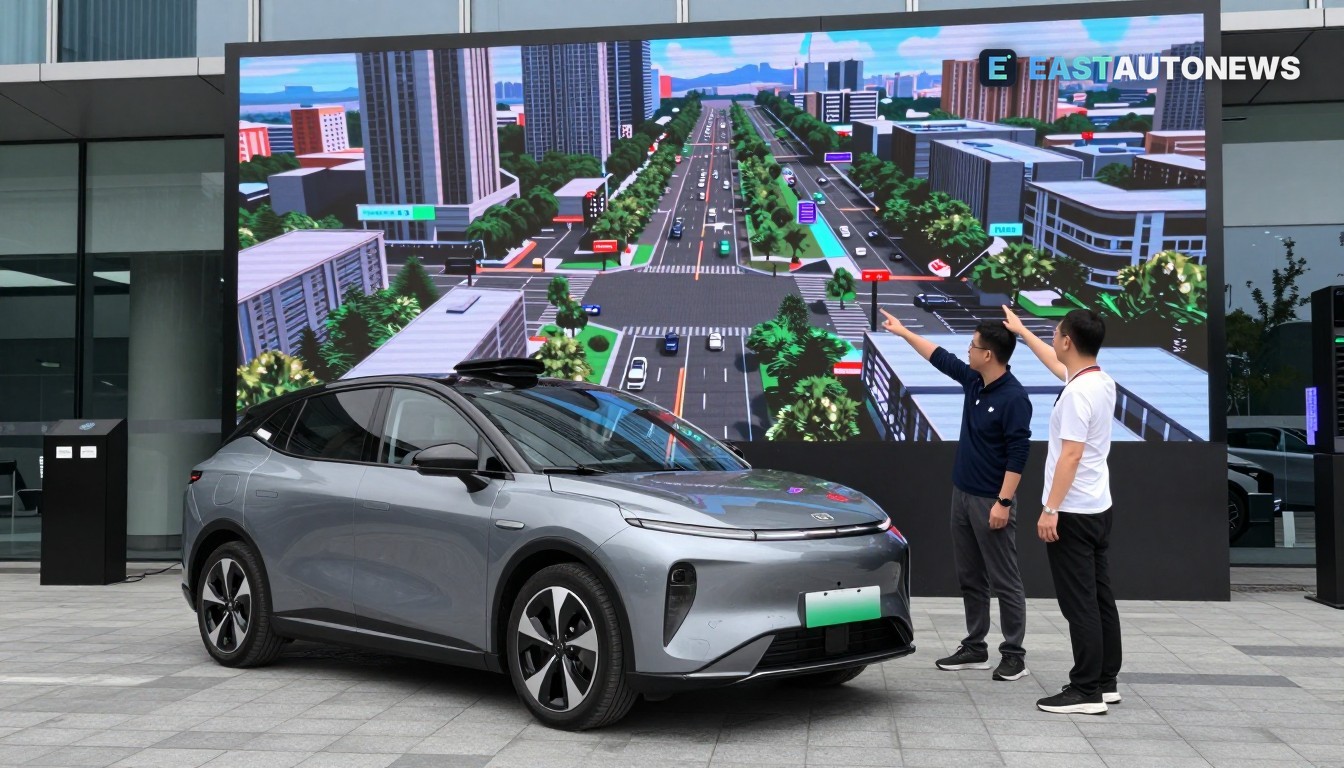
On November 3, 2026 Baidu’s Apollo unit disclosed Apollo World, an "agent-driven multimodal world model" designed to simulate whole robotaxi trips — from order acceptance to drop-off — and to generate real-time camera and lidar observations for autonomous‑driving systems. The company says the system can produce "up to 100,000 km" of simulated driving per day and that Apollo World is already being used in validation and training for its Apollo Go robotaxi fleet.
What Baidu showed and why it matters
At the Apollo session of Baidu AI Day in Shenzhen the team framed Apollo World as a closed‑loop environment where other road users are modelled as decision‑making agents that react to the vehicle under test, rather than as scripted objects. Baidu presented the capability as a way to run complete, interactive trips in a virtual city while feeding synthetic multimodal sensor streams back into the driving software. Company speakers described a ‘‘2+3’’ evaluation framework for world models that stresses causality and interactivity plus physical accuracy, persistence and real‑time responsiveness.
Baidu also pointed to the scale of data behind the model. Reporting notes that Apollo Go — the operator using the system — has accumulated very large real‑world volumes that help train the simulator; outside reports cite figures such as millions of rides and hundreds of millions of kilometres of real driving used as training data. The firm argues simulation can compress costly road testing: Baidu compares a day of virtual driving to years of on‑road safety‑driver miles.
What this means for the market
For the Central and Eastern European (CEE) auto sector, the announcement is noteworthy even though the technology was unveiled in China. World models that can run interactive, sensor‑accurate trips make it faster and cheaper to adapt autonomous stacks to varied urban layouts, traffic behaviour and infrastructure — all of which matter when robotaxi suppliers or Chinese autonomous‑tech firms expand into European and CEE cities. If simulation materially reduces the need for long, costly local road‑testing, vendors and operators can iterate software more quickly and lower the up‑front capital costs of demonstrations and pilots.
That matters to local players and suppliers in several ways: Tier‑1 software and sensor suppliers will face new fast‑moving data and simulation requirements; vehicle upfitters and fleet operators may see shorter timelines to pilot approvals; and regulators in EU and CEE markets will need to weigh how virtual validation complements on‑road evidence when assessing safety claims. Those are market effects and not company promises; regulators and local trials will still demand real‑world proof.
Baidu’s move also raises the competitive bar for rivals — established robotaxi players and automakers planning L4 pilots in Europe — and for any OEMs seeking to certify automated functions across different national rules and driving cultures. Several Chinese robotaxi firms and EV makers have signalled plans for overseas rollouts; suppliers and fleets in CEE should track whether world‑model validation becomes accepted evidence in European pre‑deployment regimes.
Electric vehicle listings on WorldTrader24 →
Sources: Reuters, TechNode