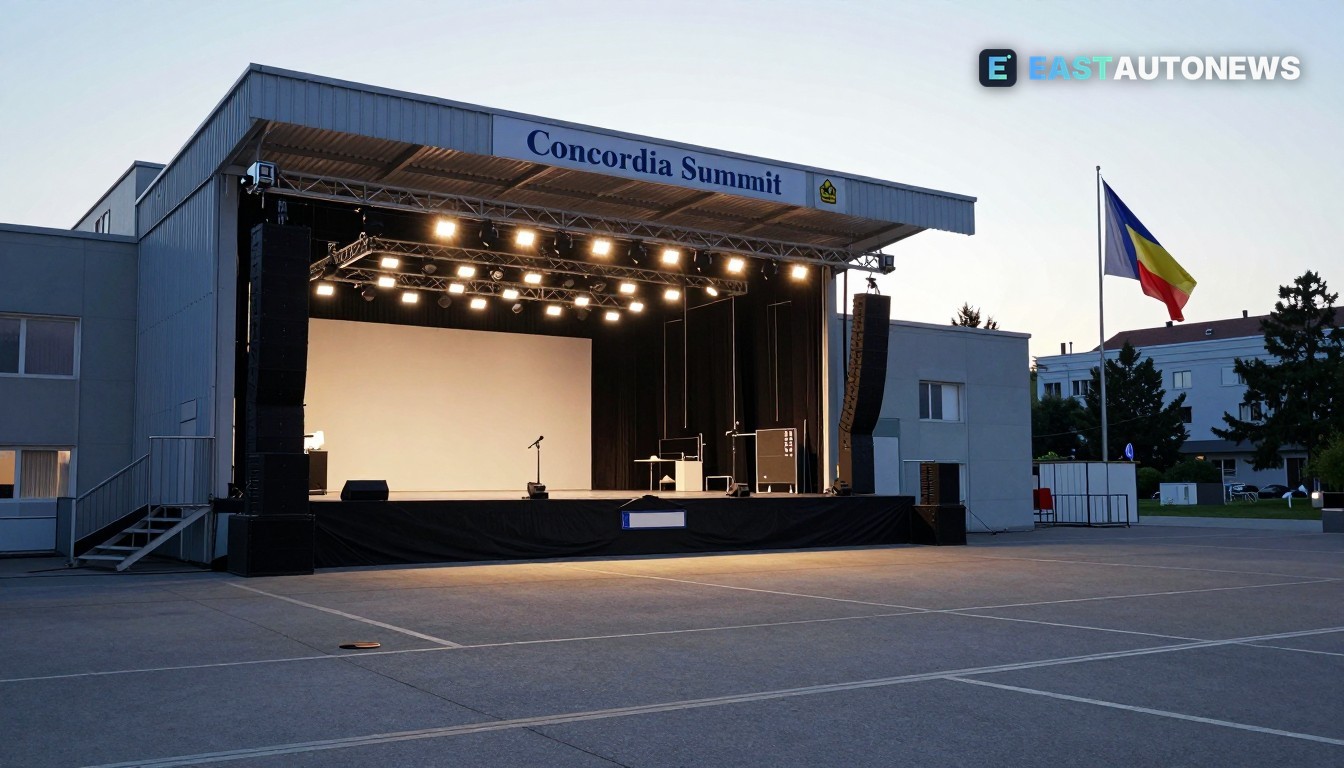
Romania has received two bids to host an EU‑style AI Gigafactory and the national selection is now in its final phase, Finance Minister Alexandru Nazare said on 6 November at the Concordia Summit in Bucharest. "Following nearly a year of effort, Romania currently has two bids on the table for an AI Gigafactory... I hope that by the end of the year, we will be able to wrap things up with a positive announcement," Nazare told the conference.
How it fits the EU gigafactory push
The announcement lands amid the European Commission and the EuroHPC Joint Undertaking's drive to select up to seven large AI computing centres — so‑called AI Gigafactories — intended to boost European training, fine‑tuning and inference capacity for advanced AI models. The Commission's call, launched on 30 July, is backed by up to €10 billion of EU and national funding and is intended to unlock at least €20 billion in private investment. Member States and industry consortia can bid to host the facilities.
The procurement is split into lots and phases, with minimum compute multipliers and a two‑stage finance model set out in the call documents; deadlines for large‑scale proposals (Lot 2) and medium‑scale proposals (Lot 1) were adjusted during autumn 2026 to allow Member States more time to finalise national commitments. The EuroHPC procurement framework envisages award decisions in early 2027 and operational ramp‑up within months of contract signature.
What this means for the market
For Central and Eastern European automotive companies — OEMs, tier‑1 suppliers and software houses — closer, sovereign AI compute capacity would shorten model training cycles, reduce cross‑border data transfer constraints and lower latency for cloud‑assisted development workflows. Manufacturers moving to software‑defined architectures and more ambitious ADAS/AD programmes increasingly require large, repeatable training runs and validation environments; access to an EU‑backed gigafactory would be a material operational lever.
Romania’s statement that two bids exist is the first concrete progress signal from a CEE state actively positioning itself as a host for such compute capacity. If a Romanian site is selected and the winning consortium guarantees compute access for regional users, suppliers in Romania, Bulgaria, Serbia and neighbouring markets could gain lower‑cost, higher‑assurance access to the kinds of AI infrastructure now concentrated in Western Europe and North America. That could accelerate local R&D, validation of ADAS stacks and the emergence of specialized AI tooling companies for the automotive sector.
Timing remains tight. National selection processes are running in parallel with the EuroHPC call; Nazare emphasised the Romanian procedure has moved in parallel with the European timetable and that details will be revealed once formal decisions are taken. The exact bidders, contract values, timelines and the guarantees on industrial access have not been published.
Immediate vehicle listings on WorldTrader24 →
Sources: AGERPRES, European Commission