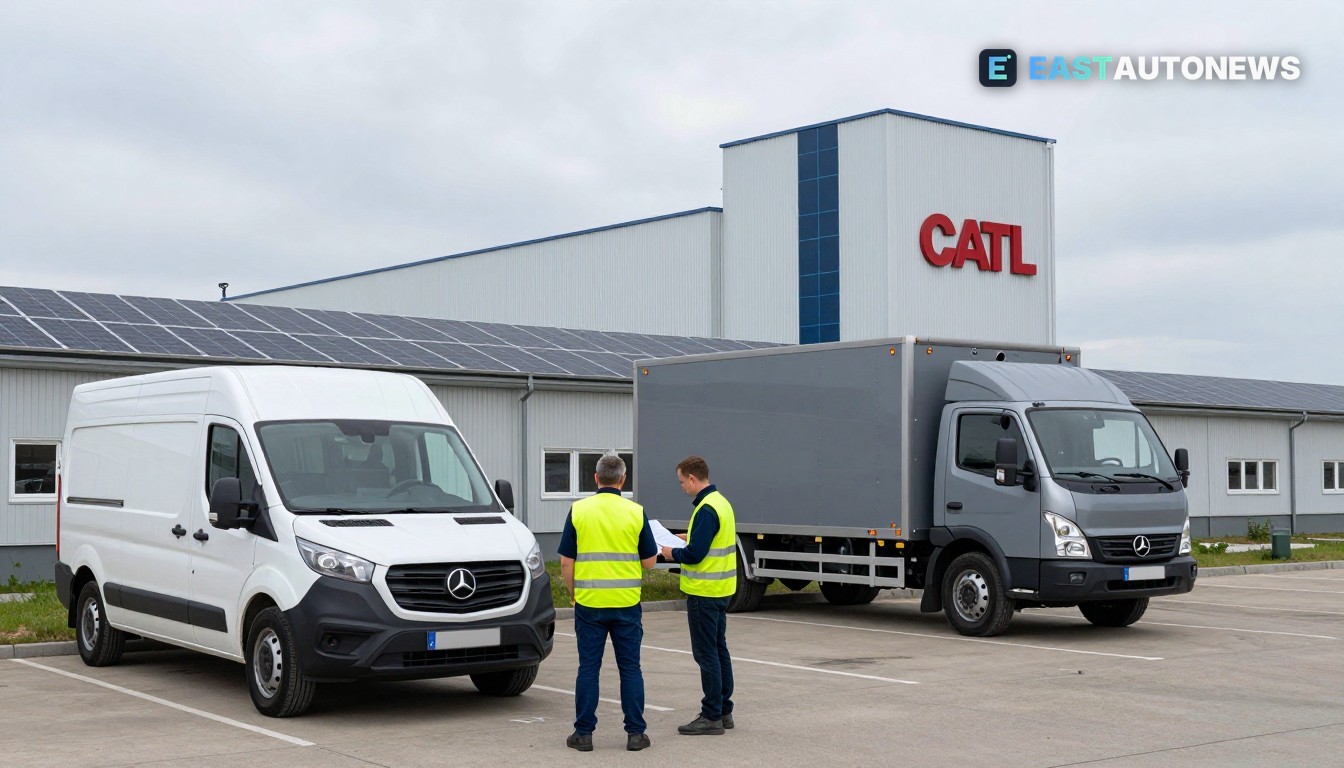
New industry data published in early November shows China’s Contemporary Amperex Technology Co. (CATL) has sharply increased battery deliveries outside China — driven in large part by Europe — a development that will reverberate through Central and Eastern Europe’s car supply chain.
SNE Research’s October tracker, highlighted in reporting on Nov. 8, 2026, shows CATL’s non‑China battery volume rose to 143.7 GWh through September 2026, with deliveries to Europe expanding 35.4% year‑on‑year to 96.8 GWh.
Why the numbers matter to CEE
Those figures matter locally because CATL is not only exporting cells into European vehicle production chains but has also moved production into the region. CATL’s Debrecen, Hungary cell factory began trial production on its first two lines on 22 September 2026; the site’s first phase is reported as roughly 34 GWh with a planned full capacity of 100 GWh.
For Central and Eastern Europe — where vehicle assembly volumes for global carmakers remain high and where battery cell demand is concentrated — the dual effect of larger overseas shipments plus local cell output tightens the region’s access to lower‑cost LFP (lithium iron phosphate) capacity and broadens CATL’s negotiating leverage with automakers and tier‑one suppliers. SNE Research’s tracker also shows the three major Korean suppliers (LG Energy Solution, SK On and Samsung SDI) saw combined non‑China volumes fall, a dynamic analysts say is reshaping supplier competition.
What this means for the market
Short term, carmakers in Hungary, Poland and neighbouring CEE states that already source cells or modules locally can expect a deeper pool of Chinese cell supply inside Europe — potentially easing near‑term shortages but increasing price pressure on local suppliers. CATL’s stronger overseas margins and the firm’s growing presence in Europe also reinforce the strategic importance of local content for OEM purchasing decisions.
Longer term, the ramp of a 100 GWh‑scale site in Debrecen (when fully built) would materially change capacity maps in Europe. That could accelerate OEMs’ willingness to rely on locally produced Chinese cells — while intensifying political and regulatory debates over resilience, origin rules and security of supply that directly affect CEE policy choices. SNE Research data underpin the immediacy of the shift: rising LFP adoption for entry models and CATL’s expanding overseas share are already visible in the numbers.
Automotive suppliers and regional governments face a choice: lean into rapidly available cell volume and absorb related competitive pressure, or prioritise policies and incentives that defend or grow domestic/Korean/EU cell projects. Either route will shape investment decisions at Tier‑1s and in logistics across the CEE manufacturing belt.
WorldTrader24 B2B-Fahrzeugmarkt für Händler →
Sources: SNE Research, East Asia Brief, CATL / PR Newswire, CnEVPost