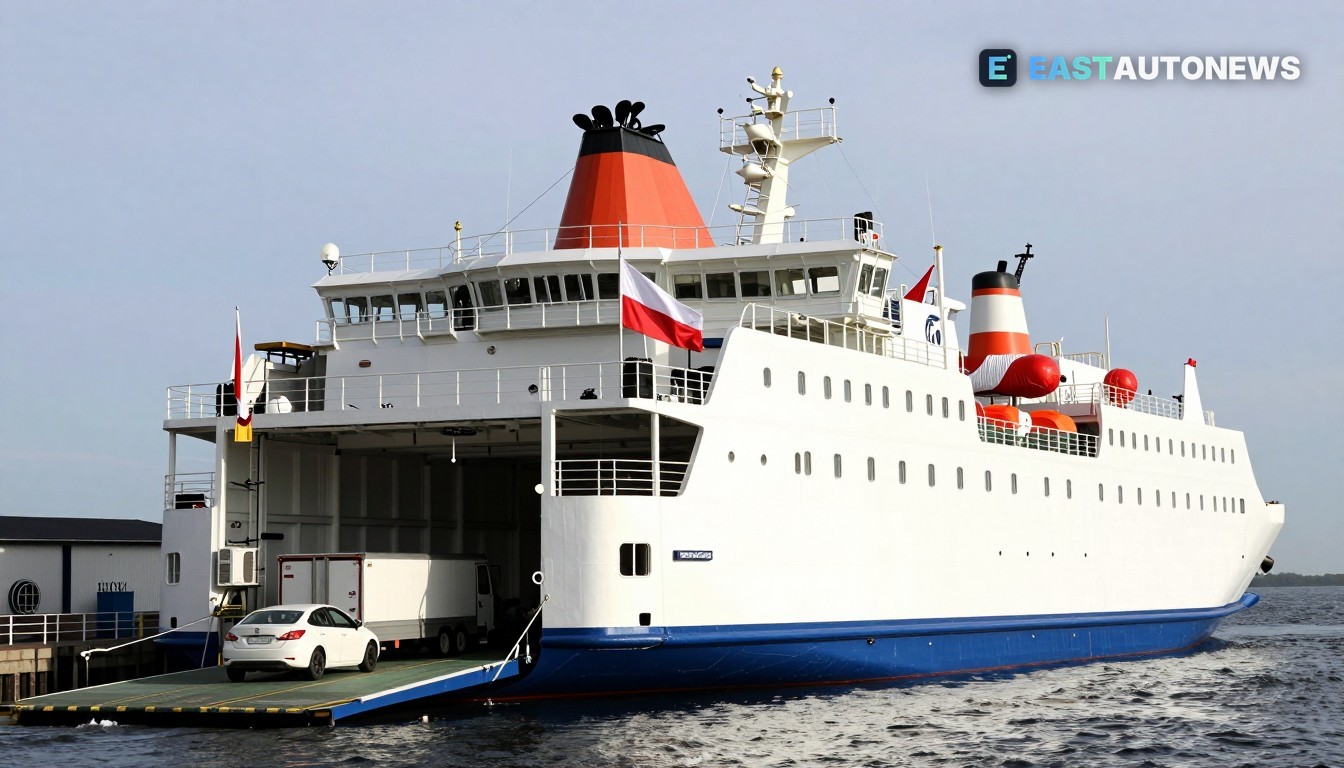
Poland raised the flag on M/F Bursztyn Unity in Szczecin on 11 November 2026, marking the return of a large Polish‑flag ro‑pax ferry after roughly two decades and adding short‑sea lift capacity for wheeled freight between Poland and Sweden.
Vessel, route and timing
The Bursztyn Unity — a sistership to January’s Jantar Unity — was formally christened at Wały Chrobrego in Szczecin on Poland’s Independence Day, 11 November 2026. Government statements and local coverage say the vessel is due to begin scheduled commercial service on the Świnoujście–Ystad route from 18 November 2026.
Unity Line’s published timetable shows Bursztyn Unity listed in the operator’s roster for sailings valid from 16 November to 14 December 2026, underlining the operator’s plan to put the vessel into short‑sea rotation in the coming week.
Ship technicals and official remarks
Officials highlighted the ship’s modern, lower‑emissions machinery at the christening. TVP and the ministry said Bursztyn Unity uses a hybrid propulsion package: four dual‑fuel engines capable of running on liquefied natural gas (LNG) or marine diesel, combined with battery support. The Ministry of Infrastructure framed the ferry as a Polish project built in Polish yards and returning Polish flag to the Baltic fleet.
Prime Minister Donald Tusk attended the ceremony and formally handed the Polish flag to the vessel’s captain, according to the Prime Minister’s Office schedule of events. The Ministry said the ferry will strengthen national capacity for ro‑pax and ro‑ro trade on the Baltic.
What this means for the market
Short‑sea ferries and ro‑ro/ro‑pax services are a critical limb of vehicle logistics for Central and Eastern Europe: they carry finished cars, light commercial vehicles, finished‑vehicle trailers and rolling parts between ports and gateways that feed inland distribution hubs. Adding a modern ro‑pax with greater trailer and passenger capacity on the Świnoujście–Ystad link increases scheduled lift and schedule resilience for vehicle exporters and importers using Baltic routes, particularly on Poland–Scandinavia flows. The operator timetable and ministry statement make clear the extra capacity is due to enter service from 18 November 2026.
For CEE carmakers and parts exporters that rely on short‑sea connections to reach Scandinavian and North European markets, the practical effects are straightforward: more booked sailings, potentially lower roll‑on/roll‑off waiting times at peak periods, and an extra vessel that can be used to handle overflow when container or ro‑ro slots elsewhere are tight. The environmental angle — LNG dual‑fuel engines and battery support — also aligns with shipping decarbonisation goals that increasingly shape procurement and port access in Europe.
Transporter for dealers on WorldTrader24 →
Sources: Polish Ministry of Infrastructure (gov.pl), TVP Info, Unity Line timetable