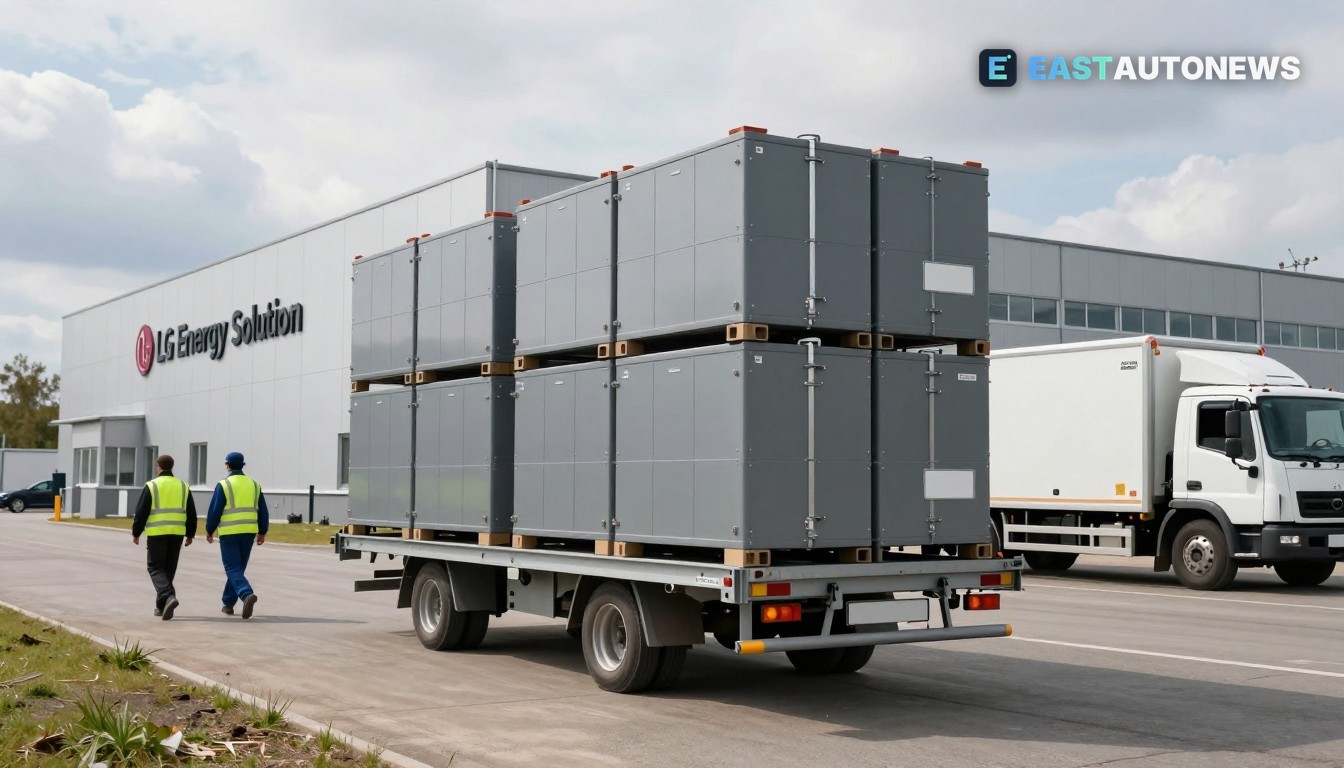
LG Energy Solution has begun reconfiguring parts of its Wroclaw (Biskupice Podgórne) battery complex away from high‑volume pouch cells for passenger EVs and toward energy‑storage system (ESS) production, the company and industry trackers said on Nov. 20, 2026. The group hosted an Open Media Day on Nov. 26 focused on stationary ESS manufacturing as it marks ten years of operations in Poland.
Conversion, contracts and capacity
Industry reporting and LG’s own communications put the cumulative capital investment in the Wroclaw site at about PLN 25 billion and current employment at roughly 6,500 people. Management is reallocating selected pouch‑cell assembly lines to lithium‑iron‑phosphate (LFP) chemistries and adding dedicated mid‑nickel pouch capacity for higher‑voltage applications.
Part of the commercial rationale is already visible in signed utility deals: state‑owned Polska Grupa Energetyczna (PGE) contracted the plant for roughly 981 MWh of ESS hardware destined for the Żarnowiec project, while an agreement with Energix covers about 2 GWh of storage procurement, industry reporting states. The Żarnowiec facility is planned to enter commercial operation in 2027.
Why LG is shifting lines now
LG told local and corporate channels that the pivot responds to a prolonged slowdown in regional EV demand and to evolving EU rules that encourage localised, closed‑loop battery manufacturing and stationary use cases. The company also flagged plans to add 46‑series cylindrical capacity in future phases (targeted from 2029) to broaden its product mix.
What this means for the market
For Central and Eastern European auto makers and suppliers, the Wroclaw retooling tightens near‑term access to pouch cells made at Europe’s largest EV battery site. OEMs that previously relied on surplus pouch‑cell output for mid‑volume models may face greater competition for remaining EV cell slots or need to accelerate sourcing from alternative suppliers (LFP makers, cylindrical lines or imports). The move also accelerates demand for ESS‑grade packaging and module suppliers in Poland and neighbouring states, redirecting local value‑chain activity from vehicle to grid storage applications.
Market effects will vary by customer: automakers with long‑dated offtake contracts or internal cell supply agreements are less exposed, while contract manufacturers and smaller local tier‑1s that serve volume‑segment passenger cars could see pricing pressure or delivery delays if pouch capacity is reallocated. At the same time, grid operators and ESS integrators in the region gain a local, large‑scale supplier that reduces logistics and content‑compliance risk.
The Wroclaw pivot underscores a broader trend across Europe: battery makers are balancing variable EV demand with higher‑margin ESS orders and new cell formats, reshaping how and where value is captured in the CEE automotive‑battery ecosystem.
Electric car listings on WorldTrader24 →
Sources: LG Energy Solution Corporate Newsroom, East Asia Brief, CellsDesk