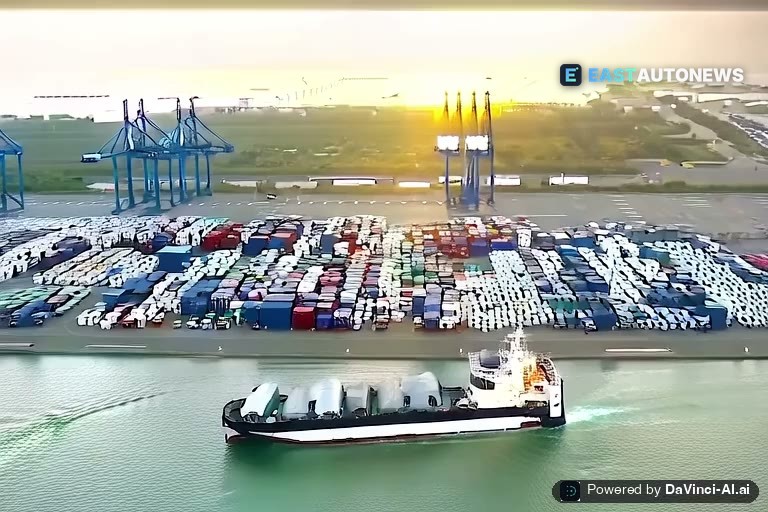
The Port of Koper has signalled a renewed push to boost capacity for car handling as part of a wider investment surge that is reshaping logistics links for Central and Eastern European vehicle makers and suppliers.
Results and investment
In a financial update published on 20 November 2026, Container News reported that the Luka Koper Group handled 972,298 TEUs in the first nine months of 2026, a 2% increase year‑on‑year, and posted net sales of €308.8 million for the period. Operating profit rose to €82.8 million and net profit to €72.9 million. The report said Luka Koper invested €128.4 million in January–September 2026, an increase of 57% compared with the same period in 2025.
Alongside container works, Luka Koper is increasing capacity for vehicles. An SRM presentation published in mid‑November sets out a plan to expand the car terminal, with the port targeting a capacity exceeding 1.1 million vehicles once a new storage facility is completed (the timeline indicated in the slide set points to completion by 2028). The SRM slides also list a dedicated car‑terminal expansion budget of about €47 million within an overall port investment envelope.
Traffic shift: containers up, vehicles down
While container throughput is on the rise, vehicle volumes have been weaker this year. Luka Koper recorded 646,209 vehicle movements in the first nine months of 2026 — a 6% decline compared with the previous year — which the port attributed mainly to weaker exports from European manufacturers to the Eastern Mediterranean and Far East. The port nonetheless forecasts further container growth, expecting roughly 1.286 million TEUs by the end of 2026 and targeting about 1.338 million TEUs for 2027.
What this means for the market
The investment signals a strategic bet that the Northern Adriatic will remain a key gateway for CEE carmakers and their suppliers even as global flows shift. Expanding car‑storage and handling capacity to roughly 1.1 million vehicles — alongside continued container investments aimed at lifting capacity toward 2 million TEUs by 2030 (SRM data) — should reduce bottlenecks for Ro‑Ro and roll‑on/roll‑off logistics serving Slovenia, Austria, Hungary and northern Croatia. For manufacturers with assembly or component hubs in Hungary, Slovakia and Poland, better access to an expanded Koper could shorten transit times to Asia and improve export routing flexibility.
However, Luka Koper’s own figures show the near‑term challenge: vehicle throughput in 2026 is down versus 2025, reflecting weaker demand on some export corridors. Port capacity gains will matter most if hinterland rail and road upgrades keep pace; SRM and Luka Koper both flag that hinterland infrastructure and rail links are critical to converting terminal upgrades into faster, more reliable car logistics.
For suppliers and tier‑one firms, the port’s enlarged car and container capacity could ease capacity constraints that have pushed shipping to northern European hubs and increased overland road and short‑sea legs. The €128.4 million of investment recorded in the first nine months underlines the operator’s willingness to fund projects that support both containerised supply chains and vehicle handling, but the pace of completion and the state of connecting rail links will determine how rapidly CEE automakers feel the benefits.
WorldTrader24 B2B vehicle marketplace for dealers →
Sources: Container News, SRM / Intesa Sanpaolo presentation