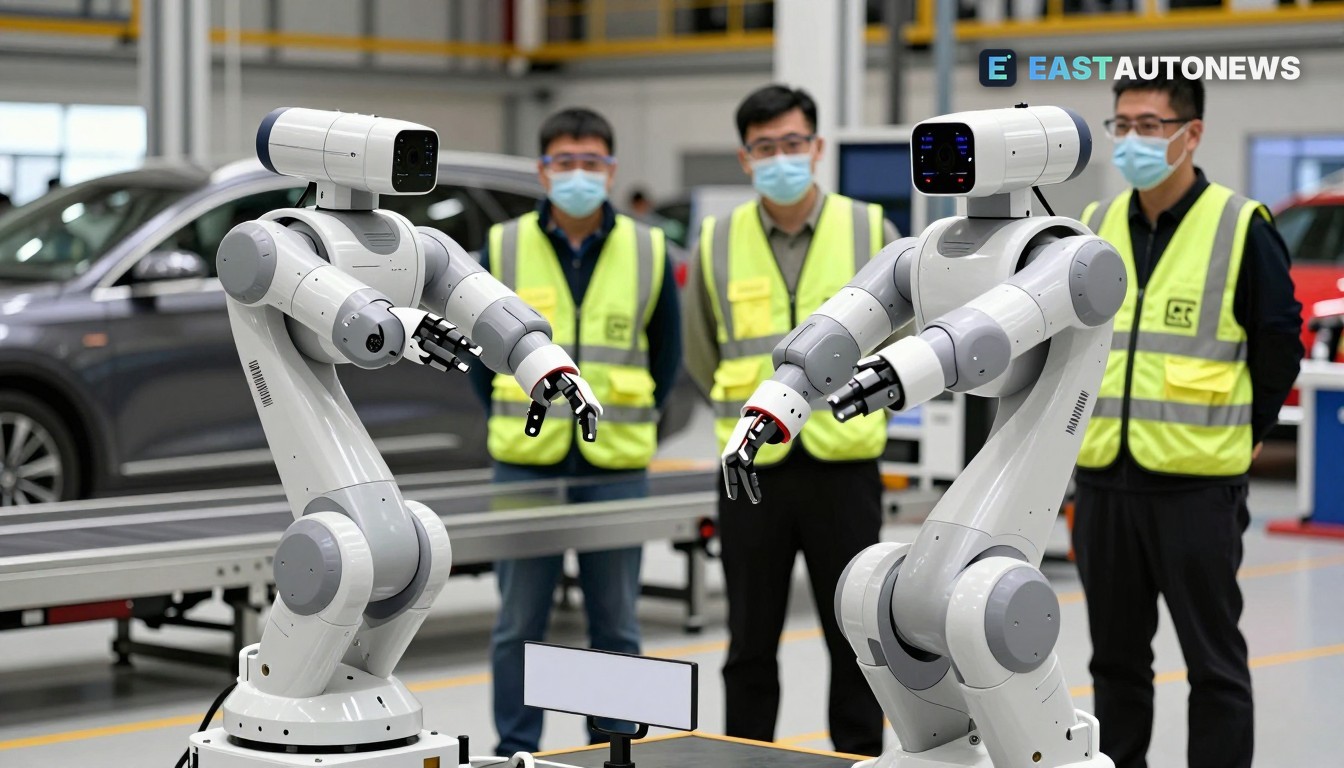
Volvo Cars has begun training AEON humanoid robots from Hexagon Robotics at its manufacturing plant in Ghent, Belgium, with the machines learning precise component‑placement tasks alongside shopfloor staff as a prelude to a factory pilot in 2027.
Trial set‑up and robot specs
The programme uses imitation learning: Volvo operators demonstrate a task and the AEON units copy the motions as they are trained to place parts into two fixtures with high precision. Volvo says the robots will be given progressively harder tasks — from handling multiple parts to moving around the production area and interacting with existing automated equipment — as each step is proven.
Volvo’s press material lists the AEON robot as 1.65 metres tall and weighing 60 kilograms, equipped with cameras and sensors for perception. The machine moves on wheels (not legs), can travel up to 2.4 metres per second and carry up to 10 kilograms, and is described as a multi‑purpose platform that can be trained for different industrial tasks.
Pilot timeline and partner comments
Volvo said the training in Ghent lays the groundwork for a factory pilot in the first half of 2027 and that the aim is to use AEON units in real production from mid‑2027. The Ghent facility is the automaker’s first plant to trial humanoid robots.
Volvo Chief Manufacturing Officer Magnus Nilsson is quoted saying: “AEON’s humanoid design means it can fit into our production as it is today, alongside our teams and existing automation. Our aim is for humanoid robots to take on some of the most physically demanding tasks and help make work more ergonomic for our people.” Hexagon Robotics’ president Arnaud Robert added that close collaboration between the companies aims to ensure AEON “performs real‑world tasks that support their manufacturing process.”
What this means for the market
Volvo’s Ghent trials put humanoid robotics squarely into the mainstream factory conversation in Europe. If AEON reaches mid‑2027 production at Ghent, it would join a short but growing list of automakers experimenting with flexible, human‑shaped robots to complement fixed automation and support ergonomically challenging tasks. Early training and staged validation reduce integration risk and let manufacturers assess where humanoids add value — notably in mixed‑model lines and tasks that are hard to automate with conventional arms and fixtures.
For suppliers and plant operators across Europe, the Ghent pilot underlines two practical shifts: factories will need richer, labelled operational data and systems to train perception and imitation models, and change management will become a core competency as humans and embodied AI work together on the shopfloor. Success in Ghent could accelerate demand for modular tooling, mixed‑reality operator interfaces and edge compute tailored to low‑latency robot perception and control.
Regulatory and workforce issues remain. Trials that emphasise human‑in‑the‑loop training and staged deployment help manage safety and acceptance, but broader roll‑outs will still require formal certification, staff reskilling and clear governance of task boundaries between humans and robots.
WorldTrader24 B2B vehicle marketplace for dealers →
Sources: Volvo Cars, Automotive Manufacturing Solutions
Partner note: EastAutoNews technology partner DaVinci AI develops AI solutions for the entire automotive industry – from market and dealer analytics to autonomous AI agents and image and video production.