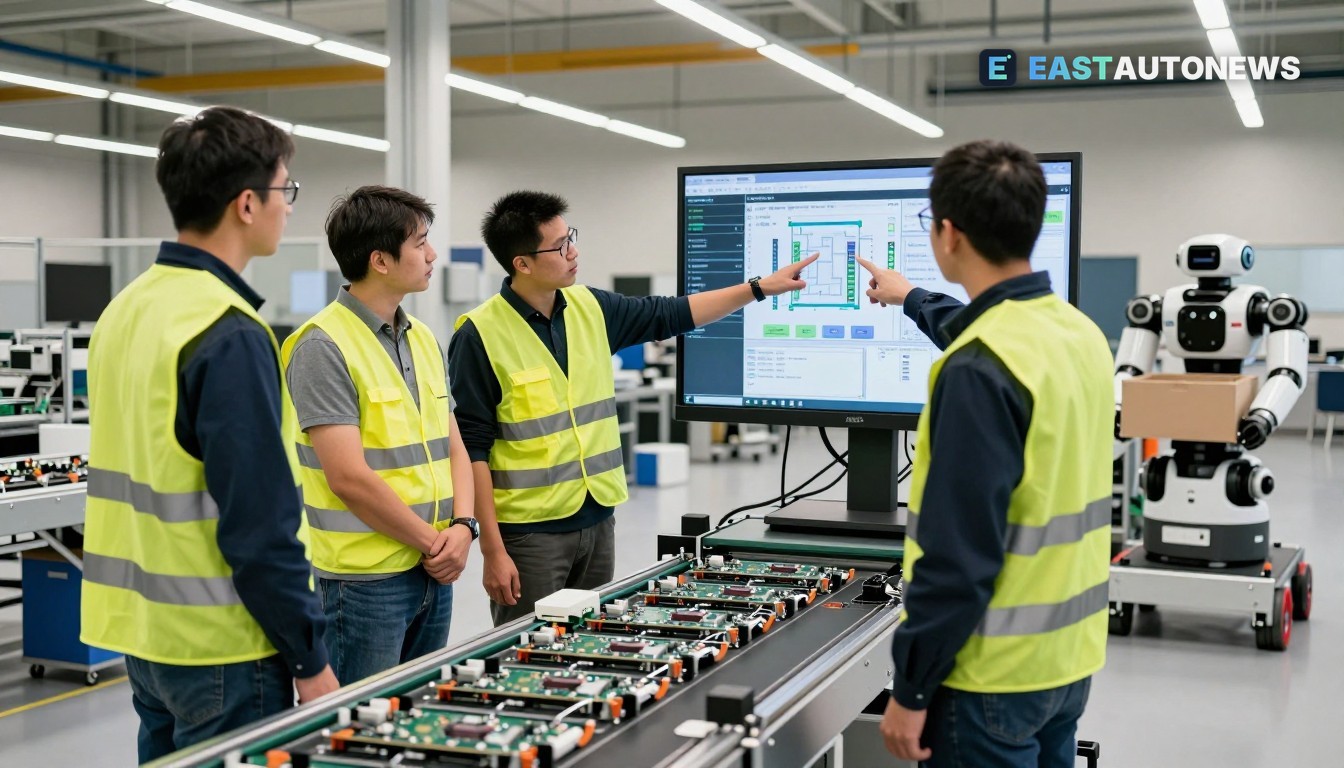
Siemens announced this week that its electronics factory in Erlangen, Germany, will be turned into what the company calls the world’s first fully AI‑controlled plant, layering an “AI brain” on top of digital‑twin models to plan, test and implement changes in real time. The company said the initiative combines Siemens’ industrial software and automation with NVIDIA’s simulation and AI toolset to speed inspection preparation, production planning and continuous optimisation.
How the system works on the shop floor
Siemens described a workflow in which engineering data — design drawings, bills of materials and manufacturing data — is used to create a photorealistic digital twin of printed circuit boards and the full factory. NVIDIA’s simulation tools then generate both flawless and defective board images (a “virtual gold sheet”), allowing camera‑based quality‑control systems to be trained before the first physical prototype exists. According to Siemens, that approach reduces the engineering time needed to prepare inspection systems by up to 85% and can deliver products to market as much as 40% faster in the best case.
For production planning, Siemens says an AI agent now prepares multiple production scenarios when orders arrive, scores them against key performance indicators and tests them on the plant’s digital twin before a human planner approves changes. Siemens estimates the approach could cut costs by about 20% and allow the factory to respond faster to material shortages or shifting orders.
Robots, humanoids and live testing
The company also reported work with mobile and humanoid robots in Erlangen. Siemens said it tested the HMND 01 humanoid robot in logistics roles; the machine reportedly handled 60 crates per hour, operated more than eight hours and met performance targets in over 90% of attempts. The factory already runs more than 100 AI algorithms across production, logistics, quality control and maintenance, and employs roughly 1,000 people. Siemens has assigned several hundred industrial AI experts to the project and plans further roll‑outs of completed applications.
What this means for the market
Siemens positions the Erlangen project as a blueprint for wider industrial AI adoption: the company says factories can run more adaptively when an AI layer continuously analyses a digital twin, virtually tests improvements and translates validated changes to the shop floor. Siemens’ executives framed the work as strategic for maintaining competitiveness in higher‑wage European manufacturing. The project — backed by a long‑running Siemens–NVIDIA partnership announced earlier this year — also turns technologies the companies sell into demonstrators that suppliers and carmakers can evaluate before adoption.
For carmakers and parts suppliers in Europe and Central‑Eastern Europe, the Erlangen blueprint highlights practical gains from digital twins, AI‑driven inspection and agentic production planning. The systems speed up new product ramps (reducing time to first‑good part), lower the manual effort needed to retrain vision systems when variant changes occur, and promise predictive improvements in maintenance and logistics. That combination can help plants in higher‑cost regions preserve competitiveness by raising throughput and cutting engineering downtime — but successful rollout will require data integration, worker training and clear human oversight, all areas Siemens says it is addressing as part of the programme.
Siemens confirmed the Erlangen factory will be further expanded through 2030 and said it is investing €500m in renovation. Company executives used vivid metaphors during the presentation — NVIDIA’s Rev Lebaredian called the digital‑twin testing capability a “time machine,” and Siemens’ Mark Hindsbo described the virtual gold sheet as a way to change production more quickly without shutting lines.
WorldTrader24 B2B vehicle marketplace for dealers →
Sources: Siemens Blog, Siemens Press
Partner note: EastAutoNews technology partner DaVinci AI develops AI solutions for the entire automotive industry – from market and dealer analytics to autonomous AI agents and image and video production.