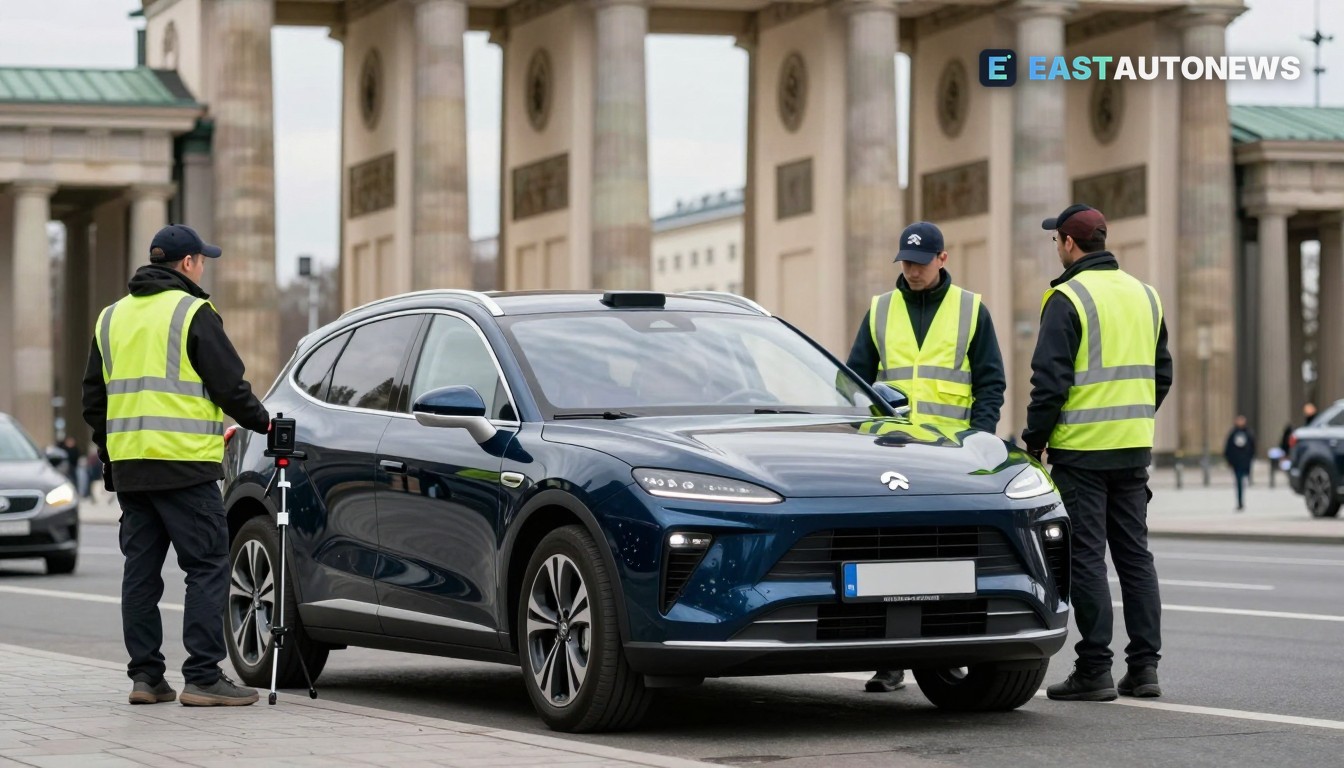
Chinese EV maker NIO has revealed that it ran a China‑trained driver‑assistance model on Berlin roads earlier this year and showed a seven‑minute video of the run in a keynote. NIO’s Head of Overseas ADAS/AD in Europe, Hezeng Wei, told AutoSens Europe attendees that the test — which the company filmed and presented as “NIO World Model in Berlin” — handled complex city scenarios without bespoke European adaptation.
What NIO showed in Berlin
Hezeng Wei described the approach as “AI‑native”: a world‑model architecture NIO has rolled out in China that reasons about multiple possible futures and selects the most likely scene in real time. Wei said NIO has “over 1 million” vehicles on the road in China and uses synthetic‑data tools to cover rare corner cases; he also played the Berlin video that includes footage past the Brandenburg Gate. In his AutoSens keynote (September 24), Wei argued the model’s behaviour showed “emergent” capability in situations not seen during Chinese training.
NIO disclosed technical claims about its in‑house hardware at the same briefing: AutoSignal reported Wei saying the NX9031 system‑on‑chip is installed in more than 300,000 cars in China and that one NX9031 equals roughly four Nvidia Orin chips in compute terms, while the company prepares a broader commercial push for its stack. The firm also cited insurer data it said showed user accident losses falling materially in China — figures AutoSignal summarised as a 38.4% reduction in the first half of 2026 in one insurer analysis cited by the company.
Why Central and Eastern Europe should watch
Although the Berlin test took place in Germany, NIO’s plan to offer its full‑stack driving solution to other manufacturers has clear implications for the European supply chain — including Central and Eastern Europe (CEE), where many OEMs and tier‑one suppliers operate assembly, software and electronics plants. If Chinese automakers can export mature ADAS/AD stacks, European carmakers and suppliers in CEE face new competitive pressure when choosing software and compute partners, and may also find fresh business opportunities to integrate or localise those stacks for regional compliance and testing.
Regulatory and validation work will be central: NIO acknowledged a knowledge gap for Europe and said it wants to work with local partners on safety frameworks and compliance, according to the keynote summary. That makes testing, validation and certification activity in Europe — and the engineering capacity within CEE countries to perform it — strategically important as suppliers and regulators assess any overseas stack offered for use in EU markets.
What this means for the market
The headline fact is straightforward: NIO says it has exercised a China‑trained world model on public streets in Berlin and is preparing to commercialise the stack beyond its own cars. For European OEMs and CEE suppliers that could speed discussions about sourcing software versus building it in‑house, and it may accelerate partnerships for validation, localisation and cybersecurity assurance. At the same time, regulators and national type‑approval authorities will need to see evidence of how such a system meets European safety and cybersecurity standards before it can be deployed at scale.
NIO’s disclosure also underlines a broader dynamic: world‑model and large‑model approaches to driving software are maturing in China, and that technical progress — paired with claims about high‑volume field data and dedicated chips such as the NX9031 — is now being presented to European audiences. Whether that translates into near‑term supply contracts or longer‑term competitive shifts will depend on regulatory acceptance, independent validation results and the commercial terms NIO offers to vehicle makers and suppliers.
NIO driving AI tested in Berlin — see wholesale listings on WorldTrader24 →
Sources: AutoSignal, Electric‑Vehicles.com, Ad‑hoc‑News