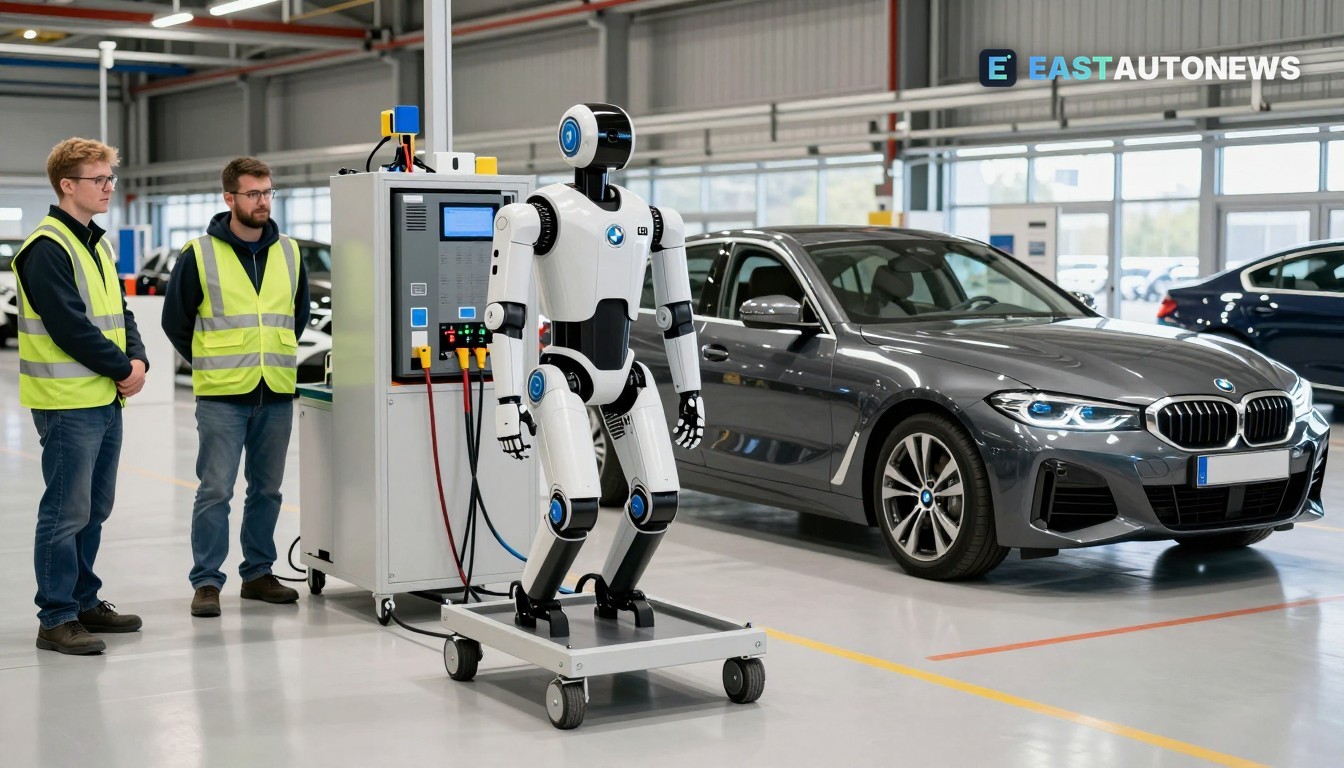
BMW Group has confirmed a live pilot of Hexagon Robotics’ AEON humanoid at its Plant Leipzig iFACTORY, with units already performing production tasks including work around high‑voltage battery assembly and component handling. The company describes AEON as a 1.65‑metre, 60‑kilogram wheeled humanoid that can move at up to 2.5 metres per second and be fitted with different grippers and scanning tools for multi‑purpose use on the shop floor.
The pilot and the technology
BMW first set out its "physical AI" programme and the Leipzig pilot in corporate material in 2026; recent independent trackers and industry reporting re‑verified the deployment and noted fresh evidence of AEON units operating in the plant’s iFACTORY environment, with a verification update dated 13 November 2026. BMW says the pilot is staged — beginning with theoretical and lab phases, moving to on‑site testing and into a pilot phase intended to assess how humanoids can be integrated into series production.
BMW frames the initiative as employee‑augmenting rather than replacement technology: the company highlights repetitive, ergonomically demanding tasks (for example battery module handling and material delivery to the line) as prime use cases where humanoids can relieve human workers and increase process flexibility. Board member Dr Milan Nedeljković is quoted saying digitalisation and AI are central to the BMW iFACTORY and a prerequisite for keeping production flexible and competitive.
How it reached Europe's factory floor
AEON was developed by Hexagon Robotics (Hexagon AB’s physical AI division) and made an initial operational debut at BMW’s Plant Leipzig in December 2025, followed by phased testing through 2026. The automotive‑industry tracker that lists humanoid deployments reports the Leipzig site as "confirmed" and shows its dataset updated as of 17 November 2026, reinforcing that the project is active in Europe now rather than merely announced.
What this means for the market
The immediate effects will be felt by suppliers, tooling vendors and aftersales/repair networks across Central and Eastern Europe. Humanoid workstations change parts‑feeding cadence, introduce new inspection and calibration needs, and raise demand for secure, low‑latency orchestration between robots, sensors and factory IT — areas where Tier‑1 and software integrators can win new business. Independent reporting this week underlines that verification of AEON at Leipzig has prompted fresh attention from suppliers and service providers in Germany and Austria, with knock‑on relevance for CEE plants that feed European assembly lines.
For labour markets the change is twofold: routine manual tasks may shrink while demand for technicians who can operate, maintain and integrate AI‑augmented systems will rise. Dealers and workshops should expect tighter tolerances on modules and more software‑centric diagnostics as production adapts to robot‑grade fixtures and AI‑driven quality systems. BMW’s corporate messaging stresses worker involvement in how robots are used, but the test in Leipzig will be closely watched by manufacturers with large CEE footprints — from workforce planning to supplier retooling.
The Leipzig pilot is not an isolated R&D note: mirrored pilots, robot integrator contracts and large‑scale robot orders elsewhere (including recent high‑volume robot supply contracts to BMW) signal that physical AI is moving into mainstream automotive manufacturing — a structural trend that will shape procurement, training and the aftermarket across the region.
WorldTrader24 B2B-Fahrzeugmarkt für Händler →
Sources: BMW Group, Humanoid Robot Tracker