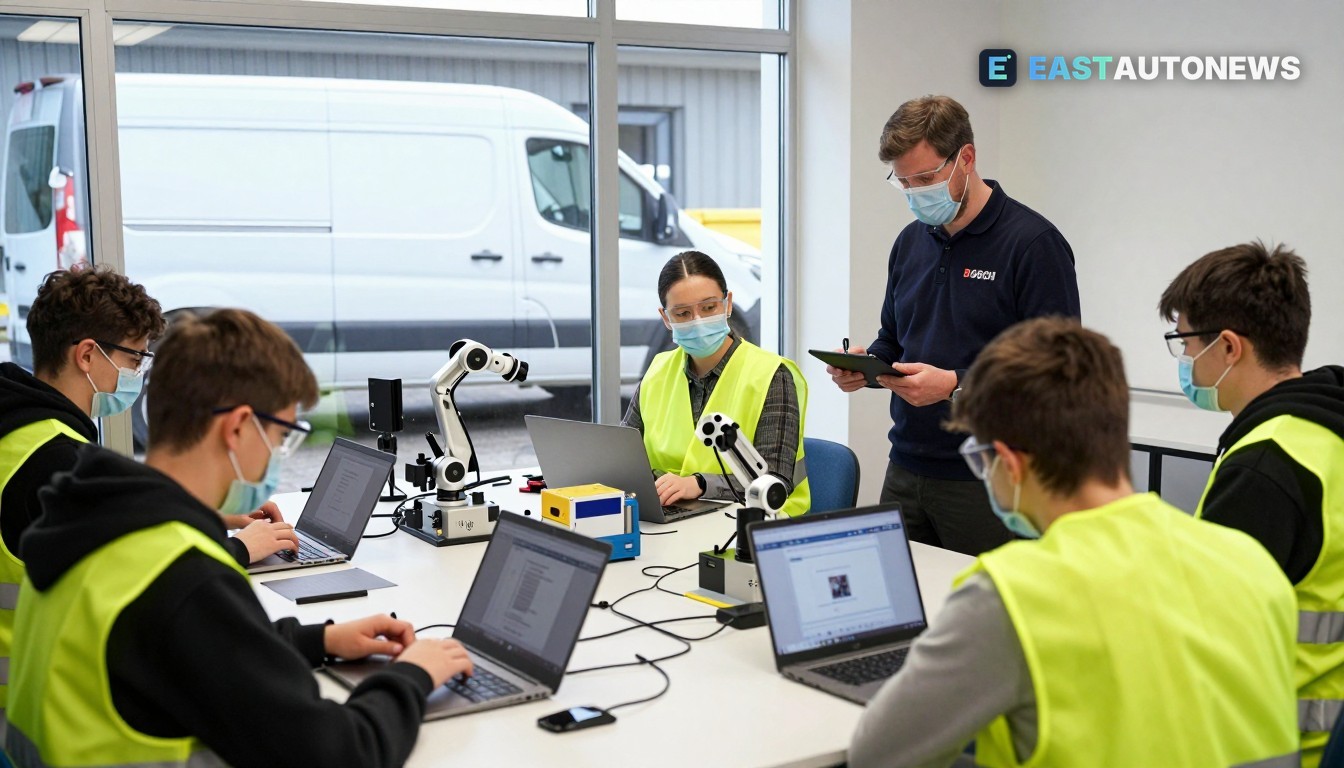
Robert Bosch’s Hungary arm said on 17 November 2026 that its nationwide artificial intelligence (AI) education programme reached Andrássy Gyula Secondary Technical School in Miskolc as part of a push to give vocational students hands‑on AI skills tied to industrial applications. The company said its teaching material will reach around 800 students in 20 secondary schools during the 2026/2027 academic year.
Programme details
Bosch described the Miskolc event as a milestone in a 15‑year partnership with the school: the original dual‑training agreement with Robert Bosch Energy and Body Systems Kft. was signed in 2011 and the power‑tool unit joined the scheme two years later. Under the local arrangement, 12 mechatronics technician students start dual training each year, so 36 pupils across grades 11–13 are continuously completing practical training at Bosch’s local training centre, the company said.
The company said the curriculum focuses on practical tasks — image and video generation, precise prompting and student‑led projects — taught by Bosch development engineers, AI specialists and PhD students, rather than by following fixed templates. Bosch emphasised the aim of teaching critical, systems‑based thinking so pupils can both use and understand AI in an industrial setting. “For us, this programme is both a transfer of knowledge and a long‑term investment. Our aim is for technician students in Miskolc to be not merely observers, but informed shapers of the industrial digitalization of the future,” said Teodóra Bodó, director of communication and governmental affairs of the Bosch Group in Hungary and the Adriatic region.
What this means for the market
The move links directly to a wider policy imperative across the EU to close digital and AI skills gaps that matter for vehicle electrification and software‑intensive manufacturing. The European Commission’s work on skills warns that the EU will need between 6.2 and 7 million AI‑related workers by 2027 and calls for stronger partnerships between companies and VET providers to address shortages in technical profiles.
For Central and Eastern Europe (CEE), where multinational suppliers and OEMs already concentrate production, programmes such as Bosch’s are a practical attempt to anchor local talent pipelines. Bosch’s Hungary briefing notes the group employed around 16,800 associates in Hungary as of 31 December 2025, underlining the scale of regional supplier activity that needs technicians with AI and digital skills. By embedding AI literacy and hands‑on projects into dual‑training tracks, supplier‑led education can reduce the lag between classroom learning and shop‑floor needs, the company argued.
While the immediate audience is secondary‑school pupils in Miskolc, the approach signals how suppliers and policymakers in CEE can co‑operate to meet EU targets on digital skills and to support the automotive sector’s transition to software‑heavy vehicles. The Bosch programme also responds to survey results the company cited showing high demand among young people for AI skills and a strong interest in incorporating AI into future studies and jobs.
Immediate vehicle listings on WorldTrader24 →
Sources: Bosch Media Service Hungary, EUR‑Lex