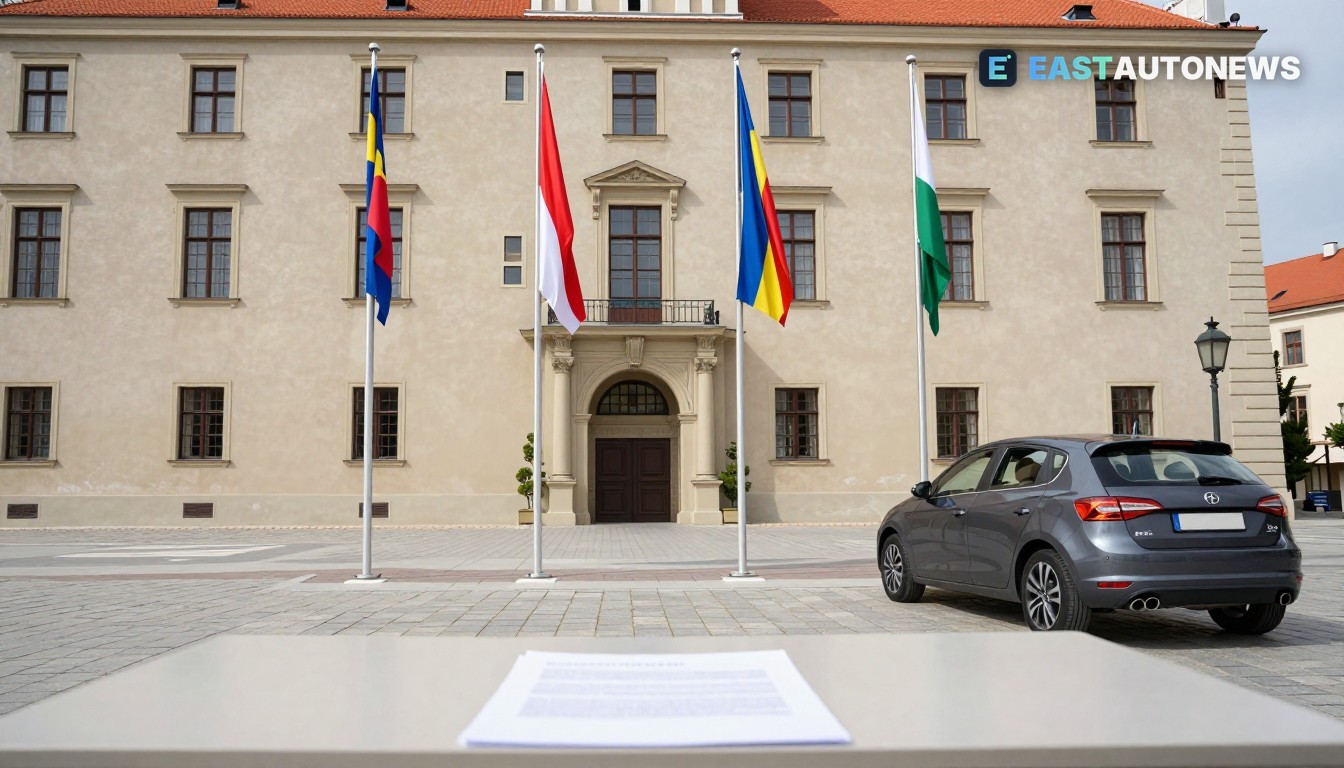
Parliamentary speakers from the Visegrad Four (Czechia, Hungary, Poland and Slovakia) met at Bratislava Castle on 12 November 2026 and signed a joint declaration calling on EU institutions to postpone the start of the new Emissions Trading System for buildings and road transport (ETS2) until 2030. The declaration also pressed for stronger support for nuclear energy, for the automotive industry, and for fairer access to EU programmes and funding.
What V4 asked Brussels
The Bratislava declaration, agreed under Slovakia’s current V4 parliamentary presidency, says ETS2 should not be allowed to harm Central European competitiveness and investment. Slovak parliamentary speaker Richard Raši said the document will be sent to top EU officials and explicitly requests postponement of ETS2 beyond 2030; Czech and Polish representatives echoed concerns about the timing and economic impact.
ETS2 is a separate carbon-pricing system created to cover CO2 emissions from fuel combustion in buildings, road transport and certain low‑emitting industrial activities; EU institutions have planned for the system to become fully operational in 2028, with auctioning of allowances beginning earlier in 2027. The Commission and the Council have described measures to strengthen ETS2’s market stability reserve to ensure a smooth launch.
What this means for the market
For carmakers, suppliers and fleet operators across Central and Eastern Europe the V4 appeal is focused on costs and timing. ETS2 places a carbon price on fuels used in road transport and on fuel combustion in buildings — in practice raising operating costs for diesel and petrol fleets, increasing logistics and depot heating bills, and creating a new compliance and reporting burden for distributors. A push to delay implementation would buy time for automakers and parts suppliers to adapt procurement, production and energy strategies and for member states to design revenue‑recycling measures.
Politically, the V4 move signals coordinated lobbying by a bloc that hosts major vehicle and parts plants: the declaration aims to influence the final text of ETS2-related rules and the EU’s 2028–34 budget negotiations where cohesion funding and transition support are decided. If the appeal gains traction, markets may see a temporary easing in risk premia for energy‑intensive suppliers and vehicle logistics operators; if Brussels holds to the 2028 timetable, companies in the region will face a tighter window to secure low‑carbon energy, pass-through mechanisms and state support.
Observers in Bratislava noted that the declaration was also sent to other parliamentary delegations present at the meeting’s expanded V4+ session, underlining the V4’s intent to shape EU-level timing and safeguards for ETS2. The request is likely to become part of the debate in the coming weeks as negotiations on the EU’s legislative and budgetary package proceed.
Immediate vehicle listings on WorldTrader24 →
Sources: TASR, Radio Prague International, European Commission (Climate Action), Council of the EU (Consilium)