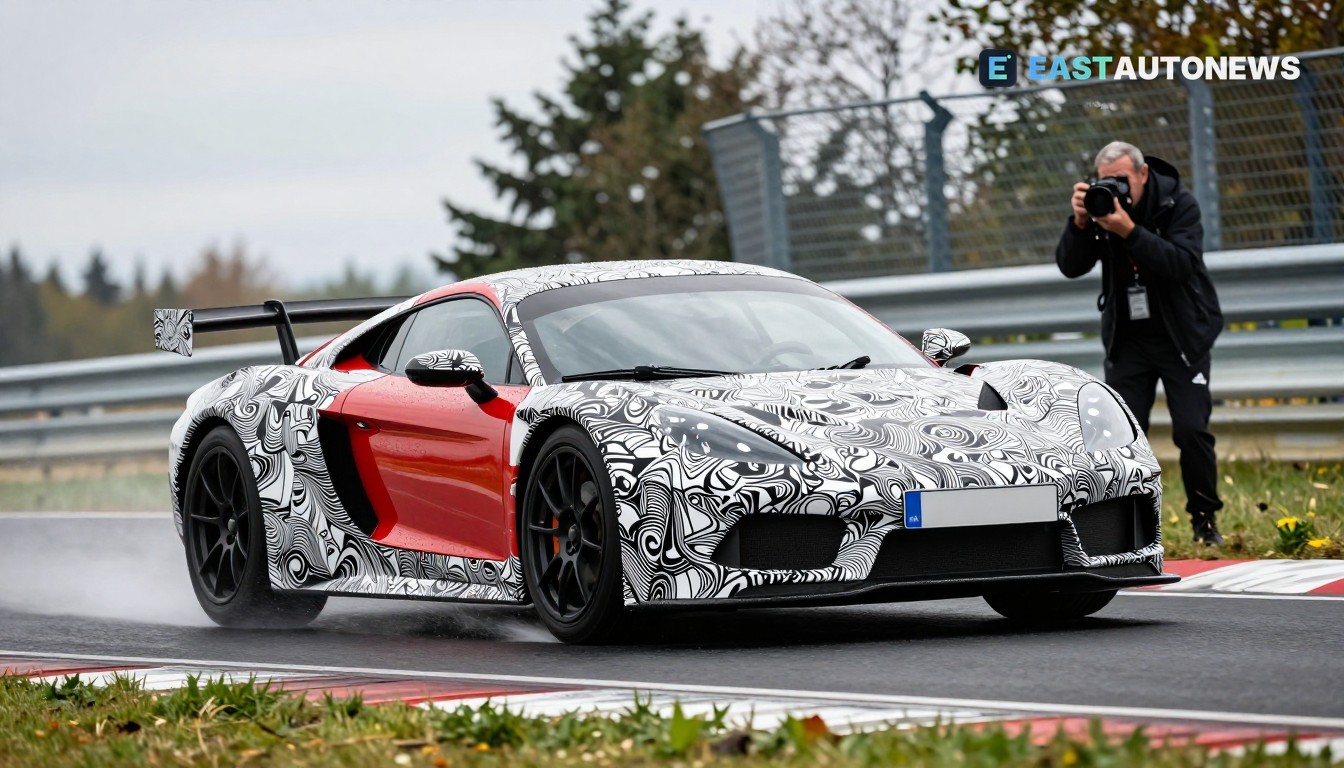
Porsche’s electric successor to the 718 Boxster was filmed and photographed with very light disguise while lapping the Nürburgring, offering what outlets call the clearest production‑ready views yet of the drop‑top sports car. Spy images show near‑final bodywork, only small covers over lights and temporary rear graphics — a level of exposure that typically signals final validation before a public reveal.
The sighting was reported in AutoPresse’s November 15 New Models / Spy Shots roundup and consolidates earlier spy coverage: photographers captured the prototype with little more than fake taillights and small headlamp covers, and the footage highlights a familiar 718 silhouette updated with revised front and rear lighting and aerodynamic detailing. Observers noted Porsche appears to have preserved the 718’s mid‑engine proportions while integrating EV packaging solutions.
What the images show
Spy photos and video from the Nürburgring runs show the test car on Pirelli‑spec performance tyres and wearing minimal camouflage, letting surface creases, bonnet and door shapes be read clearly. The front end appears to carry a new headlight signature and a more sculpted bumper; the rear retains the wide‑format taillight treatment seen on recent Porsche models but with temporary graphics applied where production lenses will sit. The prototype’s packaging — notably the rear bulk and apparent battery‑area contours — matches reporting that Porsche is arranging battery modules in the space previously occupied by the combustion engine to achieve mid‑engine driving balance.
What this means for the market
For dealers and enthusiasts in Central and Eastern Europe the Nürburgring sighting is significant. Porsche’s testing on German circuits is directly relevant to regional launch timing and aftersales: near‑production spy cars usually indicate a reveal window within months, and the Ring validation suggests Porsche is finalising chassis, thermal management and ADAS calibration ahead of homologation for European markets. That matters for ordering, aftermarket parts planning and residual‑value forecasts — especially for markets where Porsche demand remains strong but supply can be constrained at launch.
Technically, a near‑final prototype running performance rubber and showing finalised exterior apertures also suggests Porsche is confident on cooling and range trade‑offs for the Boxster EV; suppliers and local service networks should watch for official technical bulletins that will set training and parts‑stock timetables when Porsche confirms the model and its powertrain options.
The Boxster EV’s development spotlight will also influence competitive thinking across the region: premium sports‑car buyers in Central and Eastern Europe who were earlier hesitant on EV sports cars are likely to be swayed by a convincingly ’718‑like’ package, while fleet and corporate buyers will track homologation and CO2/ev‑tax implications for company‑car programmes.
Porsche electric models on WorldTrader24 →
Sources: AutoPresse, Car and Driver