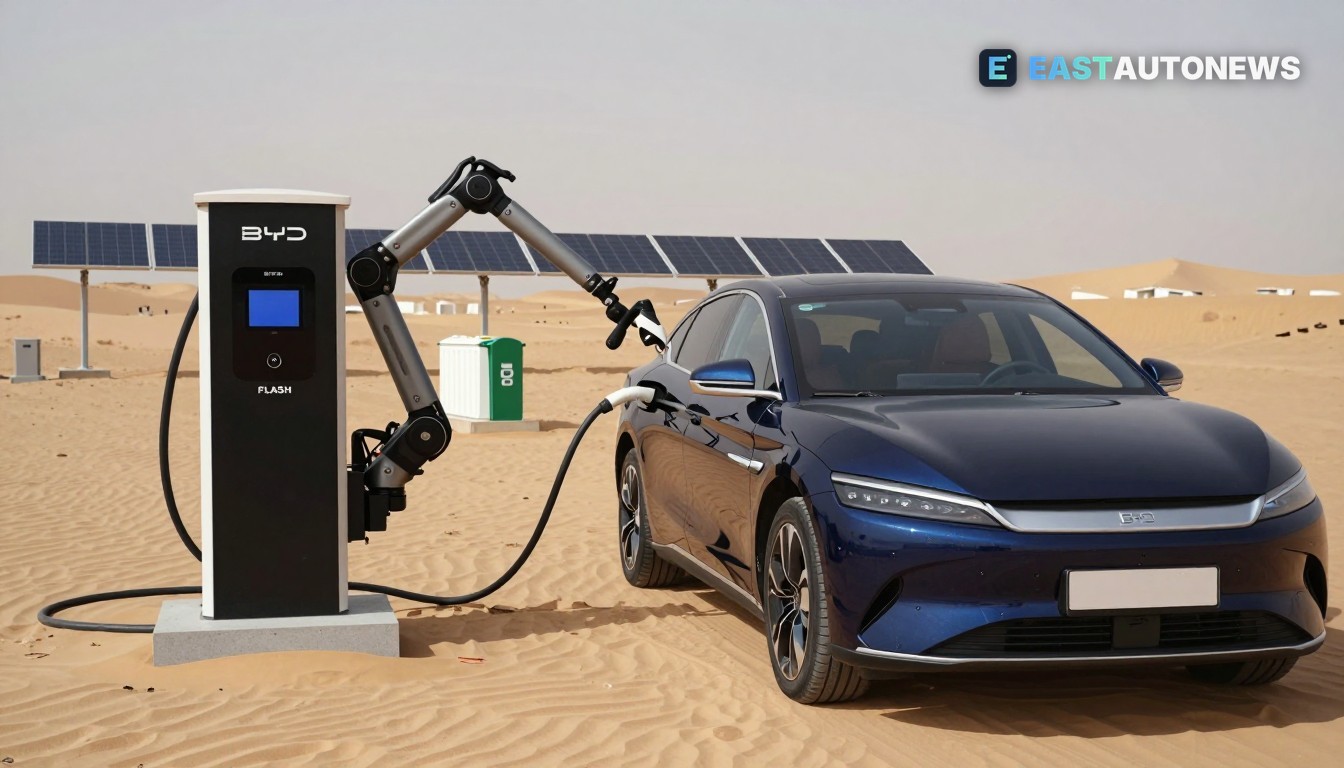
Chinese automaker BYD unveiled what it calls the world’s first integrated Solar‑Storage‑FLASH Charging and robotic charging system in the Abu Dhabi desert on 11 November 2026. The demonstrator combines photovoltaic arrays, stationary battery storage, BYD’s FLASH Charging hardware and a robotic arm that autonomously connects the vehicle for a hands‑free session.
What BYD showed and the numbers
BYD says its FLASH Charging setup can replenish a compatible vehicle from 10% to 70% state of charge in five minutes, and from 10% to 97% in nine minutes — figures the company highlighted at the Abu Dhabi event. The demonstrator is built around BYD’s Solar‑Storage‑Charging (SSC) concept and the firm says some FLASH Charging installations can require power facilities up to 1,500 kW per connector.
At the presentation BYD executive vice‑president Stella Li said the Abu Dhabi installation is “the first time BYD is bringing its integrated Solar‑Storage‑FLASH Charging technology to the global stage.” The company told media the demonstrator is a proof‑of‑concept for locations with limited grid access and part of a wider deployment plan: BYD targets thousands of FLASH sites outside China, including a stated goal of 6,000 FLASH Charging stations worldwide by the end of 2027.
Technical caveats and compatibility
Publishers covering the rollout note practical limits: FLASH Charging requires compatible vehicle battery architectures (BYD cites its second‑generation Blade Battery), a substantial local power buffer (the SSC battery store), and industrial‑grade cooling and safety systems. Reports point out BYD has not published full interoperability rules for non‑BYD cars, leaving open whether the robotic arm and extreme charge rates will be widely usable outside BYD’s own models.
What this means for the market
For Central and Eastern Europe the Abu Dhabi demonstration is significant as a technology signal rather than an immediate local deployment. BYD’s public targets for European and international FLASH stations will put pressure on regional charging operators and grid planners to consider higher‑power hubs, fast buffer storage and site selection close to industrial power supplies. If BYD pushes its rollout, fleets and local authorities in CEE will face choices about investing in large buffering batteries, fast grid connections or accepting slower, lower‑power public charging models.
Crucially, the technology also raises procurement and interoperability questions for European regulators and operators: extremely high peak power per connector changes the economics of site utilisation and may favour OEM‑led or manufacturer‑branded charging islands unless standards and cross‑compatibility are mandated. Observers say confirmation of connector standards, safety protocols and third‑party access will determine whether FLASH Charging becomes a broadly shared public resource or a manufacturer advantage.
Electric cars listings on WorldTrader24 →
Sources: TechRadar, BYD UK Media Site, EVNews, The Driven