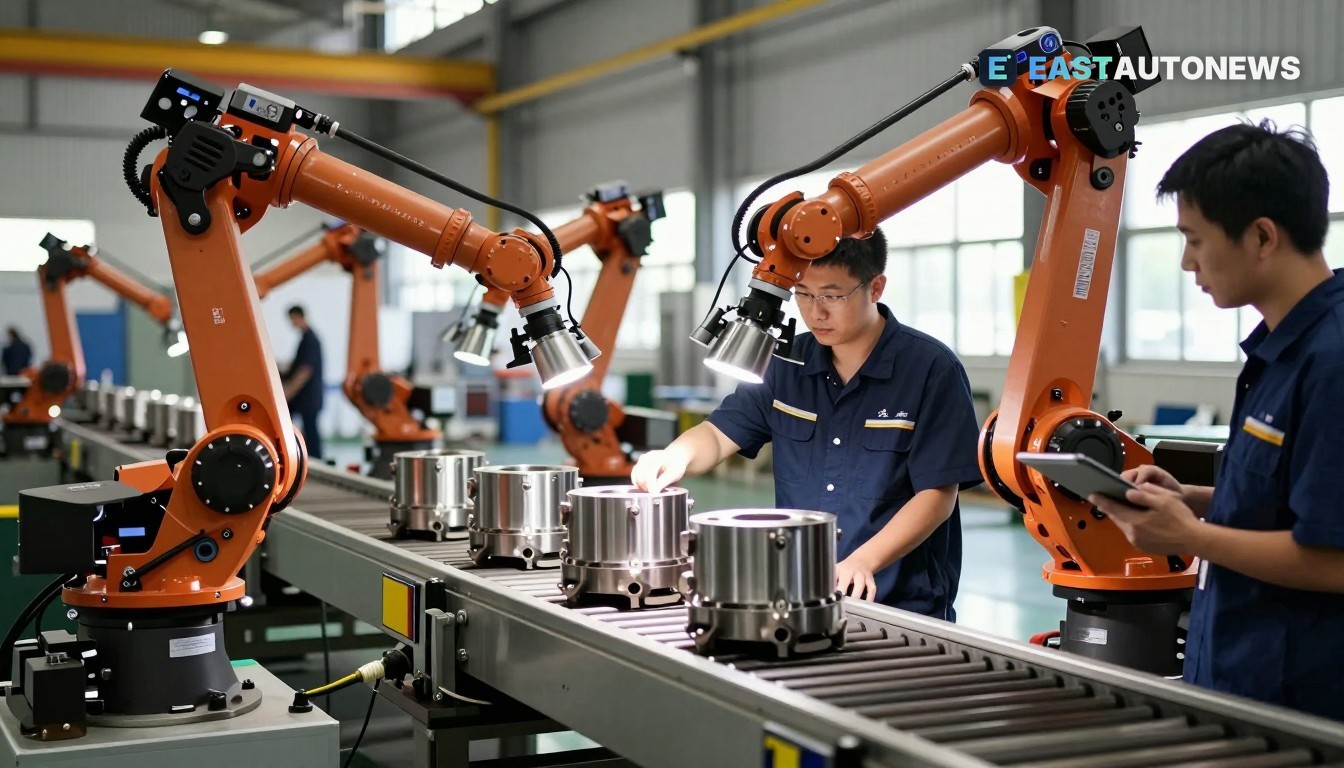
ASSIST Software has been announced as one of two winners of Volkswagen’s Automated Inspection Challenge after demonstrating a computer-vision system for 360° final inspection of cylinder heads at Volkswagen’s engine plant in Chemnitz. The company published its announcement on 17 November 2026, and industry reporting followed on 20 November.
What the challenge required
The competition — organised by Volkswagen Group Innovation together with Startup Factory boOst — tasked teams with automating a demanding final-inspection task that currently still requires substantial manual work at Chemnitz. Each cylinder head required inspections covering 157 drill holes and 24 surfaces across six sides, the organisers said. The boOst briefing and ASSIST’s account make clear the brief measured detection performance, processing speed and cost effectiveness under realistic production conditions.
Startup Factory boOst’s challenge page notes the factory still subjects “hundreds of thousands” of cylinder heads to manual inspection every year — a scale that makes reliable automation attractive if it can meet line-speed and false-reject requirements. ASSIST described its entry as an effort to encode the judgement of an experienced inspector into software and said selection followed testing, a final demonstration and jury evaluation.
Next steps and deployment
Both ASSIST and the challenge organisers say the award gives the company a concrete automotive reference and opens the possibility of further evaluation and a possible rollout at a Volkswagen production plant, subject to favourable assessment in production conditions. Integration into an existing line and real-world throughput were part of the competition brief from the start.
What this means for the market
The Chemnitz challenge illustrates a pragmatic route to industrial AI adoption used by European OEMs: narrow, production-focused pilots that test specific tasks (here, final inspection) before any broader rollout. If the winning solutions meet Volkswagen’s throughput and false-reject targets in line trials, plants that handle large series production of engines and components could reduce repetitive manual checks and reallocate skilled staff to higher-value tasks. That pathway — focused proof-of-value on one component followed by phased scaling — is increasingly visible in supplier and OEM procurement approaches across Germany and neighbouring markets.
For Central and Eastern European suppliers and tier-2 technology firms that serve European factories, the challenge model widens opportunity: startups and smaller engineering houses that prove industrial-grade AI on a narrowly defined problem can gain high-value references and faster access to procurement processes. Successful integration stories at established plants also lower technical and commercial risk for follow-on deployments elsewhere in Europe.
That said, the test underscores persistent technical challenges in industrial computer vision — reflective metal surfaces, tight geometries and borderline judgment calls — and explains why OEMs insist on on-site validation under production conditions before committing to rollouts. Vendors that couple robust imaging, careful data engineering and practical line integration planning are likeliest to pass those thresholds.
Volkswagen models available on WorldTrader24 →
Sources: ASSIST Software, Startup Factory boOst, AutoPresse
Partner note: EastAutoNews technology partner DaVinci AI develops AI solutions for the entire automotive industry – from market and dealer analytics to autonomous AI agents and image and video production.