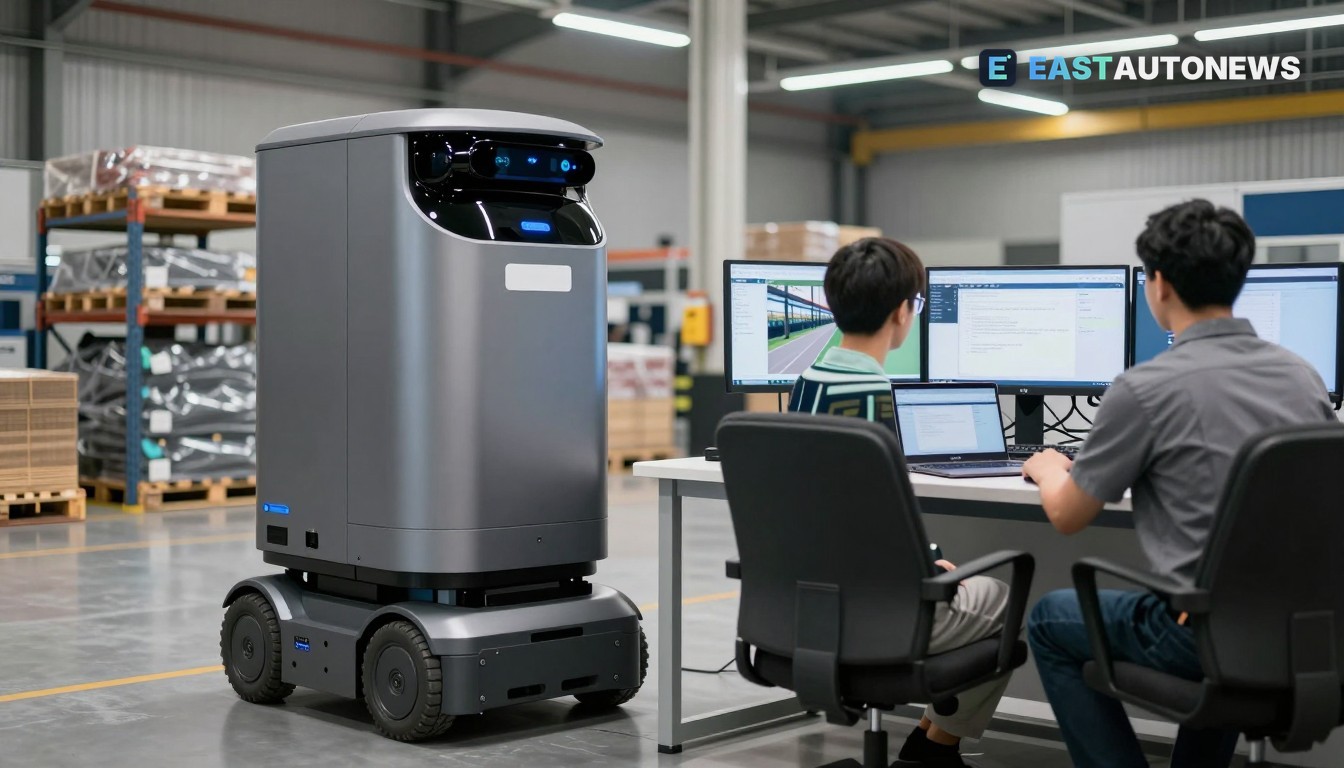
TÜV SÜD and Accenture have presented a joint “Physical AI Safety Suite” that uses digital-twin simulation, AI agents and NVIDIA tooling to prepare safety evidence for industrial robots and autonomous mobile robots (AMRs) before hardware arrives on site. The concept was shown at recent industry events and described by the partners as a way to move much of the certification work into virtual environments.
What the suite does and how it works
The suite combines three layers of safety and certification workflows: facility- and fleet-level simulation to validate routes and mixed-use zones; asset-level digital-twin simulation for functional and failure-mode checks; and a governance layer to gather and present evidence for independent review. Partners say the solution relies on NVIDIA Omniverse libraries, the Cosmos world-model platform, Isaac Sim for robotics simulation, the Halos safety platform and IGX Thor edge compute.
According to the companies, the approach lets engineers verify clearances, route planning and human-robot interaction scenarios in simulation so that inspection bodies and operators can prepare certification evidence before a robot reaches a site. That, the partners argue, reduces the bottleneck that traditionally follows hardware arrival and on-site inspection.
What this means for the market
For automakers and suppliers across Central and Eastern Europe — many of which are scaling automated warehouses and shop-floor robotics — the suite could accelerate deployment timetables. TÜV SÜD and Accenture estimate that moving key parts of the safety-assessment workflow into simulation could "start production up to 30% sooner" compared with the conventional inspection-first approach, while underlining that on-site inspection will still be required.
Faster, simulation-led certification matters to CEE carmakers and tier‑1 suppliers because lead times for installing AMRs and robotic cells are frequently prolonged by repeated site checks, rework to layouts and late-stage compliance fixes. By front-loading evidence generation, procurement and integration teams can reduce downtime between equipment delivery and production ramp-up, an advantage where margins and uptime are closely watched.
That said, the partners and independent commentators caution that simulation cannot fully replace physical trials: final acceptance will still depend on site inspections and validation of real-world behaviour. The suite is positioned as a way to de‑risk and compress the certification timeline rather than to remove regulatory oversight.
Available vehicles listed now on WorldTrader24 →
Sources: TÜV SÜD, Accenture, MarketScale, Robotics Business News, Manufacturing Digital