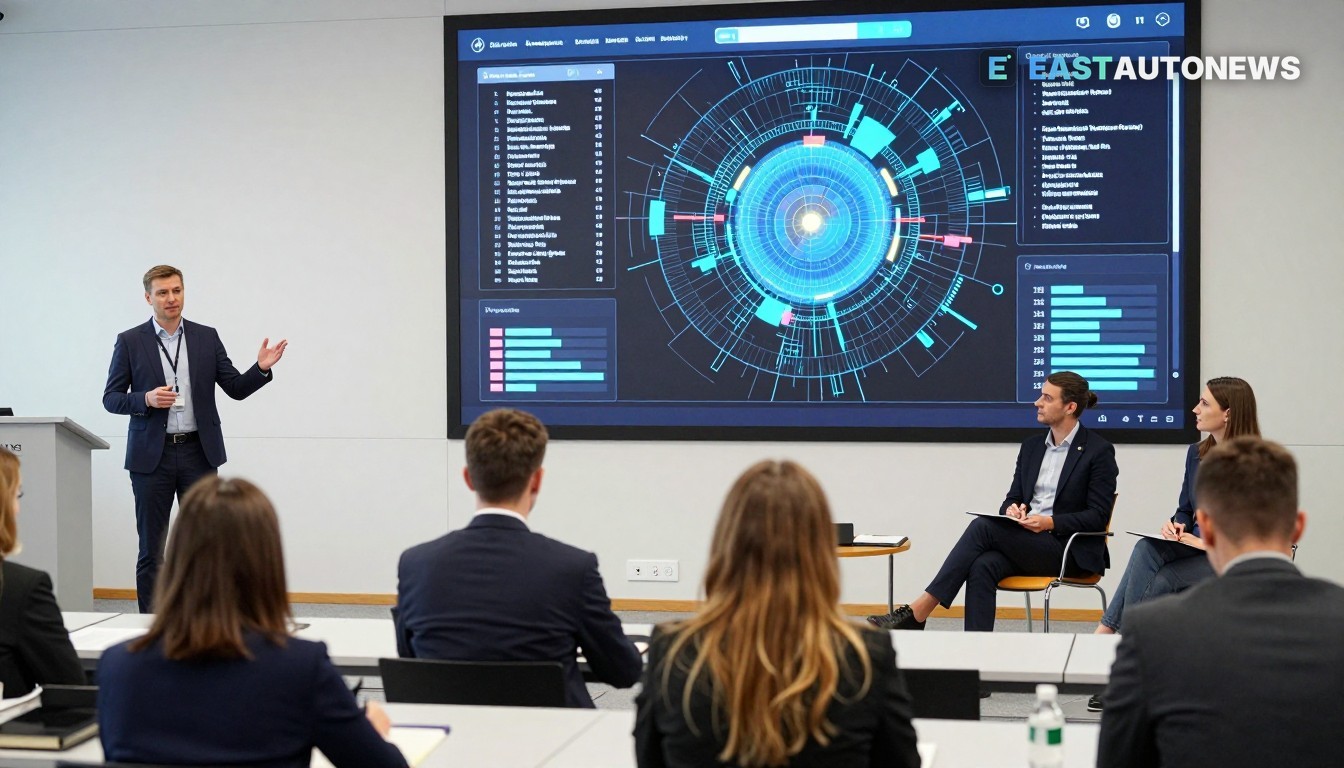
The ninth CEE Automotive Supply Chain conference in Žilina brought a focused, practical turn to discussions about artificial intelligence in the Central and Eastern European auto industry. The two‑day event on November 11–12 drew 281 participants from 14 countries and staged 385 pre‑arranged B2B meetings, organisers said.
Direct AI pilots on the shop floor
Speakers and panellists gave concrete examples of AI already being deployed across the region’s supplier base. Machine‑vision and machine‑learning for optical inspection were highlighted as established use cases, and JTEKT told the conference it is preparing to connect business processes and follow this by using AI for more effective production planning.
Porsche Werkzeugbau reported it is developing an in‑house AI agent to support predictive maintenance on production lines, while a supplier named Valient set a target to accelerate engineering work by 30% within three years through AI tools. FedEx’s customs team also described using AI and shipment‑tracking analytics to detect delays early and reroute freight when necessary.
Regulation, costs and the ‘perfect regulatory storm’
Organisers and speakers repeatedly circled back to regulatory uncertainty and cost pressures. Robert Kiml, Vice‑President of AutoSAP and President of Toyota Motor Manufacturing Czech Republic, warned that Central Europe’s current competitive position rests on past investments and that predictability is required for future projects: “We are creating the future and what it will look like here in five and ten years.”
AutoSAP’s CEO Zdeněk Petzl described a “perfect regulatory storm” that can sap development capacity as firms spend time on compliance rather than on product innovation. Panels argued that fast adoption of AI can help suppliers shorten development cycles, but only if rules, energy costs and trade frictions give firms confidence to invest.
What this means for the market
Taken together, the Žilina discussions indicate that AI adoption in CEE is moving from pilot projects to commercially focused deployments in production planning, optical inspection and maintenance — areas that directly affect lead times and unit costs. This is an inference from multiple company statements at the conference. The region’s suppliers emphasised speed, software and capacity as critical competitive levers; if companies meet their stated targets (for example Valient’s 30% engineering acceleration claim) the effect could be measurable in time‑to‑market and margins.
However, speakers also made clear that technology alone will not be decisive: stable regulatory frameworks, predictable energy costs and access to critical inputs such as semiconductors and printed circuit boards remain prerequisites for firms to scale AI investments without transferring excessive risk to OEM customers.
WorldTrader24 B2B vehicle marketplace for dealers →
Sources: AutoSAP