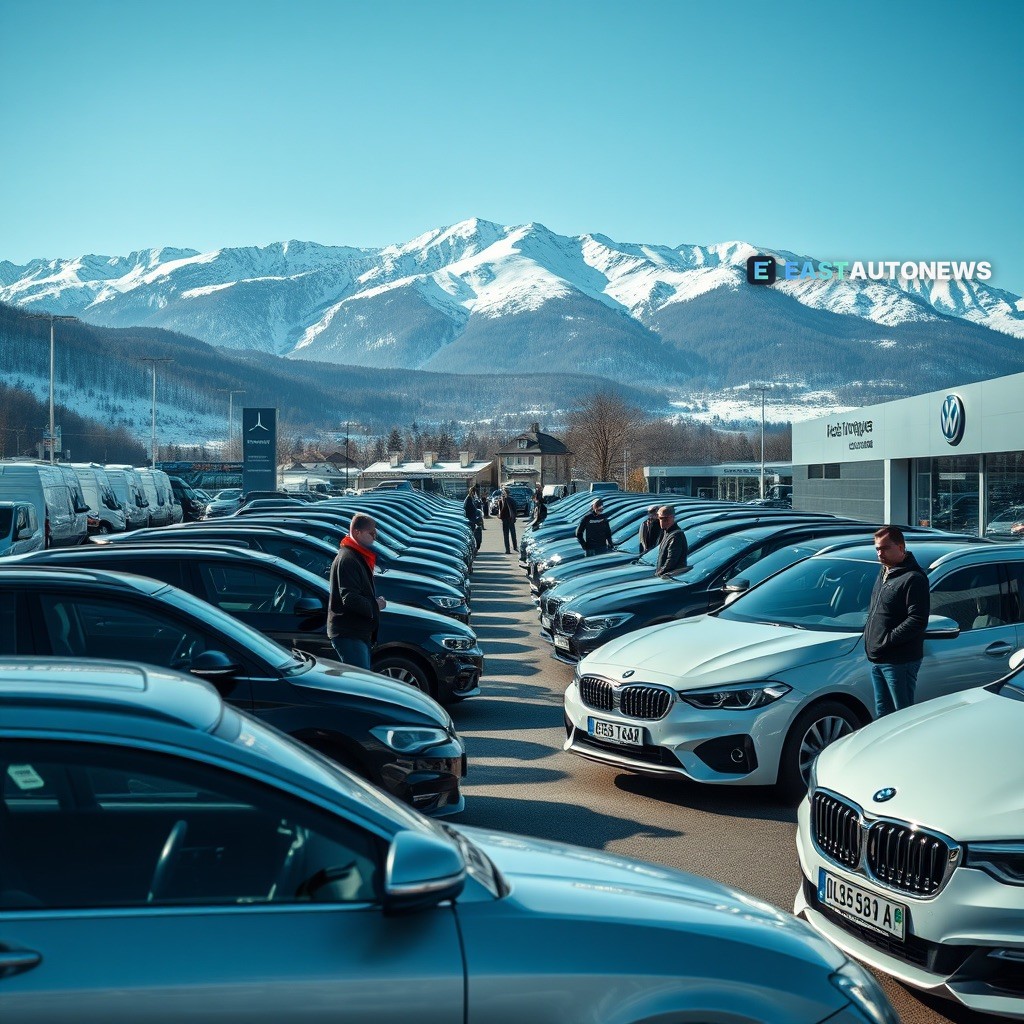
For months, the headlines out of Central and Eastern Europe have belonged to factories, battery plants and trade corridors. The region's most striking automotive number of 2026, however, comes from the showroom. New car registrations in Slovenia climbed by almost 19% between January and September, the strongest growth anywhere in CEE, according to FXStreet's regional analysis — ahead even of Hungary, the region's manufacturing heavyweight, which managed 13%. Across most of the region registrations rose; nowhere did they rise faster than in this small Alpine republic.
The figure lands alongside the International Council on Clean Transportation's European Car Market Monitor for September 2026, which tracks new registrations and battery-electric shares across the continent as the transition toward electrification reshapes demand. Slovenia's surge is a consumer-side story arriving at a moment when Europe's policy debate is almost entirely producer-side: who builds the cars, where the batteries are made, and what qualifies as European at all.
That last question is becoming urgent. Under the EU's 'Made in Europe' push, cars imported from Japan would not qualify for EU subsidies — and even models assembled in France, Portugal and Eastern Europe would benefit only if enough of their parts come from Europe. For a market like Slovenia, where buyers are clearly ready to spend, the fine print of those content rules could decide which models arrive with subsidies attached and which carry a heavier price tag.
Analysts warn that booming demand only sharpens the underlying risk. As recent commentary on Europe's automotive transition puts it, regulatory deadlines alone cannot manufacture batteries, lower production costs or preserve supplier networks — Europe can achieve a more electric automotive market without achieving a stronger European one. A 19% registration surge is precisely the consumer momentum policymakers hope to harness; whether it translates into industrial strength or simply leaks away through imports depends on how the new rules are written.
For now, the signal from Slovenia is unambiguous: CEE consumers are not waiting for Brussels to settle the industrial debate. Registrations are up across most of the region, and its fastest-growing car market is proof that the region's demand story is every bit as compelling as its production story. The task ahead is making sure the two end in the same place.
Slovenia's surge shows how quickly well-priced vehicles find buyers in today's market. Readers looking for their next car — in Slovenia or anywhere else in Europe — can explore sensational vehicles at sensational conditions at WorldTrader24, Europe's marketplace with over 70,000 vehicles.