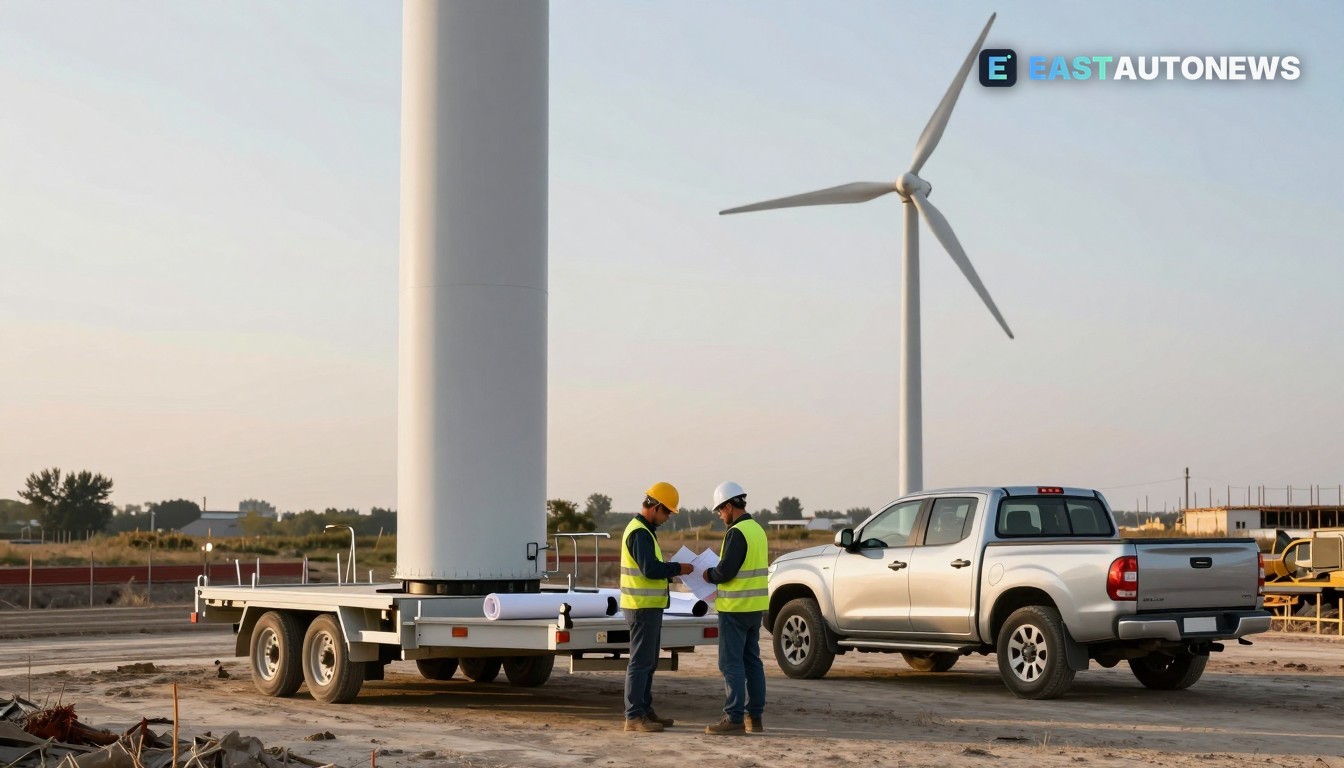
Rezolv Energy announced on 6 November that it has signed project financing of up to €367 million for the 292.5MW Dunarea East onshore wind farm in Constanța County, Romania. The financing is provided by a six‑bank consortium that includes Société Générale, Erste Group, Raiffeisen Bank International, Mizuho Bank Europe, Raiffeisenlandesbank Niederösterreich‑Wien and the European Bank for Reconstruction and Development (EBRD). The EBRD’s participation is supported by an InvestEU guarantee.
Deal details
Project offtake is supported by a Contract‑for‑Difference (CfD) allocation covering 211MW of the plant’s 292.5MW capacity, awarded in Romania’s CfD auction, and by a corporate virtual Power Purchase Agreement (VPPA) with retailer Ahold Delhaize. Rezolv says the combined arrangements underpin long‑term revenue visibility and allow the company to move to construction; the firm expects Dunarea East to be operational in early 2029. JPMorgan acted as debt‑structuring advisor and CMS and White & Case provided legal advice.
The developer and its partner Ahold Delhaize also announced a separate 10‑year VPPA covering output from Rezolv’s Dama Solar and the Dunarea East wind project; Rezolv’s disclosures cite roughly 370 GWh of annual reference volume for that corporate offtake. The structure — a CfD allocation combined with corporate offtake — was explicitly cited by Actis (Rezolv’s financial backer) as a factor that lenders viewed positively.
What this means for the market
For Romania and Central‑Eastern Europe the transaction is a near‑term example of how bankable project structures can attract international lenders and large corporate buyers. Rezolv’s deal will lift its Romanian pipeline to more than 760MW of wind capacity once Dunarea East is energised, reinforcing a rapid build‑out of large‑scale renewables in the region.
That matters for the automotive sector because Romania remains a significant vehicle‑manufacturing base in CEE: Dacia’s Mioveni plant and Ford Otosan’s Craiova factory together accounted for a substantial share of the country’s output in 2026, and producers have publicly flagged energy costs and supply as competitiveness issues for local operations. Stable, contracted renewable supply and additional grid generation capacity can reduce exposure to spot‑market volatility and supply stress that have previously forced temporary production interruptions. Those plant‑level facts and concerns have been documented in recent reporting on Romanian auto output and on‐site energy debates.
Industry financiers and developers will watch execution closely: Solar‑market analysis notes the EBRD confirmed a senior participation of up to €31.9m inside the wider package, a detail that market participants use as independent validation of bankability. The Dunarea East financing therefore serves as a case study for how CfDs plus corporate VPPAs can unlock debt for large renewables in CEE — an outcome that may ease the route to longer‑term, contracted clean power for energy‑intensive manufacturers, including carmakers and tier‑one suppliers.
Execution risks remain: construction, grid connection and the interaction with Romania’s wider system (including nuclear and hydro availability) will determine the actual delivery timetable and commercial outcomes. For now the signed financing and VPPA give Rezolv the contractual cover it says is needed to start works on the Dunarea East site.
WorldTrader24 B2B vehicle marketplace for dealers →
Sources: Rezolv Energy, Solar Industry Romania, Romania Journal