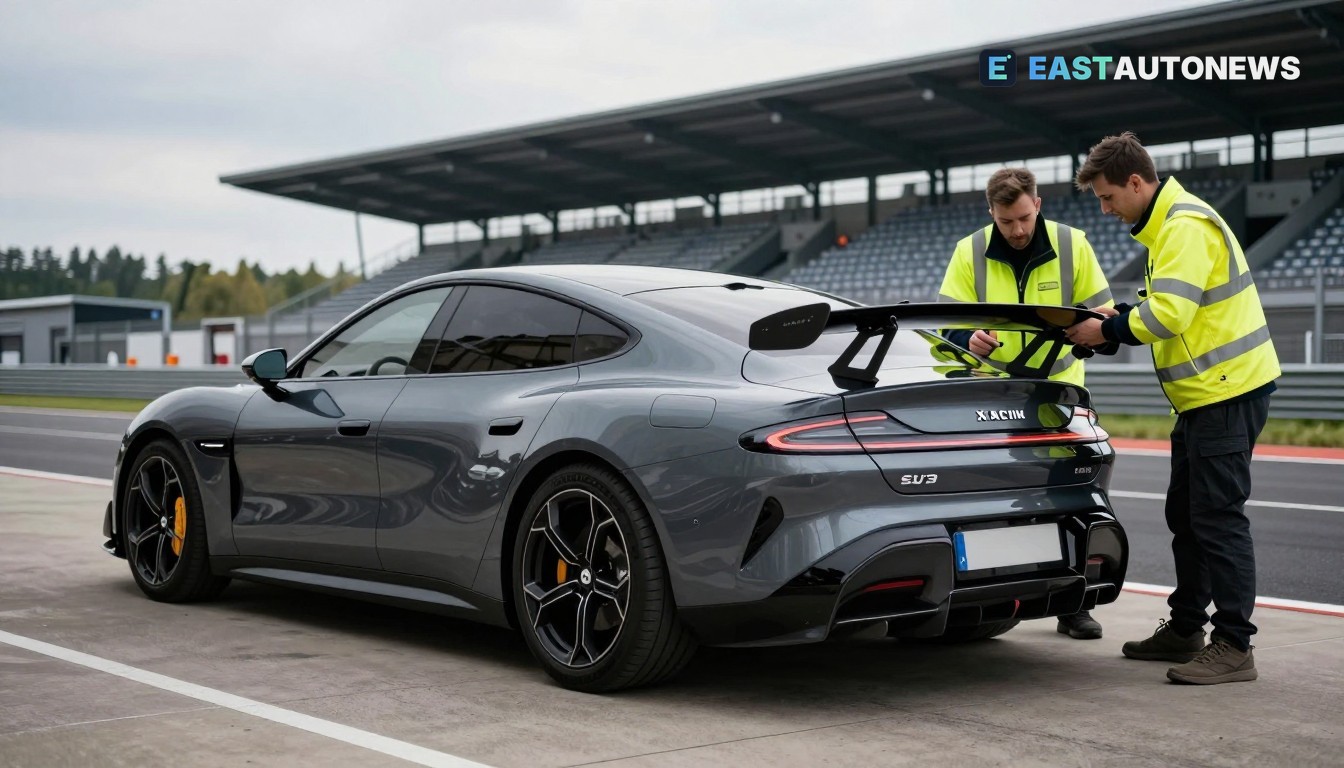
The latest spy photos from the Nürburgring show a Xiaomi SU7 Ultra prototype running without camouflage and wearing large GT3‑style aerodynamic hardware — a swan‑neck rear wing, a pronounced front splitter and vented front fenders. Photographers who published the images say the uncloaked test car appeared during a recent Nürburgring session, giving the clearest public look yet at Xiaomi’s track‑focused SU7 derivative.
The spy photos — what they reveal
Published images reveal a car that is markedly more aggressive than the SU7 Ultra currently on sale in China: large rear aero, an aggressive front bumper and louvers above the front wheels that, on similar cars, are used to relieve front‑arch pressure and improve high‑speed stability. Journalists covering the pictures note the configuration looks intended for timed laps rather than typical road‑use tuning, and outlets reporting the shots tied the uncloaked appearance to possible Nürburgring lap‑time activity. One recent report also referenced previously published power figures for the Ultra family (circa 1,548 PS for the Ultra specification) when discussing Xiaomi’s performance intent.
Where Xiaomi’s testing fits into its Europe plans
Xiaomi has been building a European footprint: the company has set up an international/unit and a Munich R&D presence as it prepares for overseas sales, and it publicly signalled plans to enter European markets from 2027. Testing at the Nürburgring and at other European verification sites — together with memoranda and dealer arrangements reported earlier this year — point to Xiaomi preparing both product and credibility for that rollout. Reporters covering the new SU7 spy images cited those broader international plans when interpreting the uncloaked tests.
What this means for the market
For Central and Eastern Europe the images matter for two reasons. First, the SU7 is a technology‑heavy electric sedan that directly targets premium EV buyers who would otherwise consider established German and other European rivals; a halo, Nürburgring‑tuned variant aims to buy credibility in performance‑conscious markets. Second, Xiaomi’s public verification work in Europe—R&D activity and Nürburgring testing—reinforces the prospect of local aftersales, homologation and dealer networks arriving sooner rather than later, which will affect competition dynamics and service‑network planning across the region if Xiaomi follows through on a 2027 launch. Those are concrete strategic considerations for OEMs, dealers and suppliers in the CEE automotive ecosystem.
Nothing in the spy photography or the reporting proves a Nürburgring record attempt is scheduled or that final production specs will mirror the prototype; Xiaomi has not published an official statement about a timed lap or a defined European timetable for the SU7 Xtreme/Ultra variant. The images do, however, underline the company’s development emphasis on high‑performance variants as it prepares to sell beyond China.
Sources: Carscoops, Autoevolution